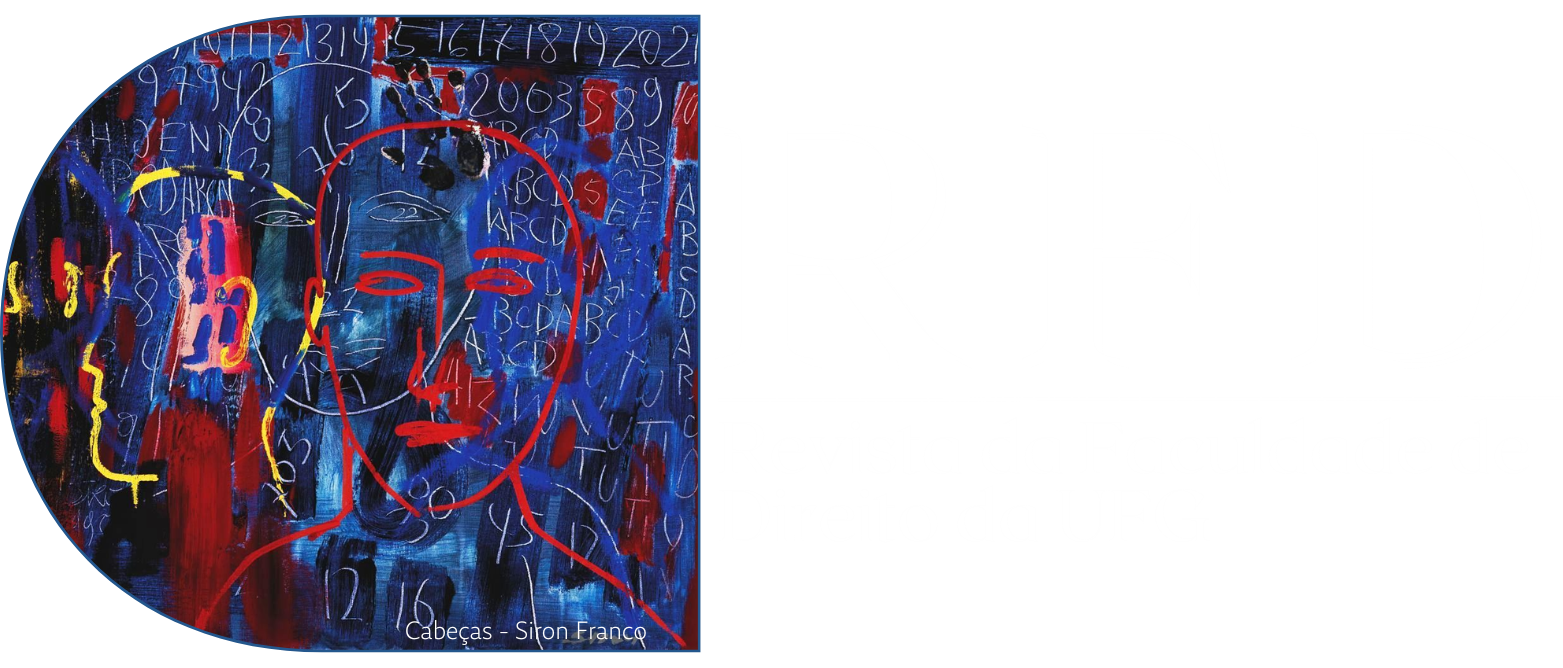
NORMATIVE COHERENCE INSUFFICIENCY
WHY DOES IT NOT FULLY JUSTIFY?
DOI:
https://doi.org/10.5216/rfd.v50i1.74692Abstract
The present is an investigation about two main questions, both on the role of normative coherence in the decisional context. Firstly, there is the concern whether coherence itself can be taken as a sufficient criteria for the justification of judicial answers, or not. That is if a decision is correctly justified for the simple fact of its internal coherence (the harmonious setting of its arguments in the particular argumentative system) and external coherence (the harmonious setting of its answer and concrete ruling and its effect on the normative sense of these given law systems) are satisfied. And secondly, if the first one is negatively answered, what are the other qualities that can be added to the justification analysis of one’s decision rationality and adequacy to the system and to the normative grounds of a given system of law? As a methodological guide to this investigation, the hypothetico-deductive method is used. But first things first, and the concept of coherence in the normative sense will need to be drawn while its role in the legal argumentation theory is better underlined. Then, it will be shown how coherence can be used to the rationalization of legal reasoning, or, in other words, how it can be used as a rational parameter of one’s argumentation. Lastly, if coherence itself is not enough, there will be the conceptual necessity for outlining what other qualities a system of arguments must have for it to can be considered as fully justified.
Downloads
References
ALEXY, Robert. Conceito e Validade do Direito. São Paulo: Martins Fontes, 2011.
ALEXY, Robert. Teoria da argumentação jurídica: a teoria do discurso racional como teoria da fundamentação jurídica. Trad. Zilda Hutchinson Schild Silva. 5. ed. São Paulo: Landy, 2020.
ÁVILA, Humberto. Segurança Jurídica: Entre permanência, mudança e realização no Direito Tributário. São Paulo: Malheiros, 2011.
BRASIL. Justiça em números 2019. Conselho Nacional de Justiça. Brasília: CNJ, 2020a.
BRASIL. Relatório de atividades 2019. Supremo Tribunal Federal. Brasília: STF, 2020b.
BUZAID, Alfredo. Estudos de direito. v. 1. São Paulo: Saraiva, 1972.
CASTANHEIRA NEVES, António. Justiça e Direito. Coimbra: Coimbra Editora, 1976.
CASTANHEIRA NEVES, António. O instituto dos assentos e a função jurídica dos supremos tribunais. Coimbra: Coimbra Editora, 1983.
DWORKIN, Ronald. A virtude soberana: a teoria e a prática da igualdade. São Paulo: Martins Fontes, 2005.
DWORKIN, Ronald. Império do direito. Trad. Jefferson Luiz Camargo. São Paulo: Martins Fontes, 1999.
FULLER, Lon L. The Morality of Law. New Haven: Yale University Press, 1963.
GRINOVER, Ada Pellegrini. Novas Tendências do Direito Processual. 2. ed. São Paulo: Forense Universitária, 1990.
HART, Hebert L.A. O Conceito de Direito. Trad. Armindo Ribeiro Mendes. 3. ed. Lisboa: Fundação Calouste Gulbenkian, 2001.
HOBBES, Thomas. Leviatã. São Paulo: Martins Fontes, 2008.
MACCORMICK, Sir Donald Neil. Argumentação Jurídica e Teoria do Direito. Trad. Waldéa Barcellos. São Paulo: Martins Fontes, 2006.
MACCORMICK, Neil. Retórica e Estado de Direito. Trad. Conrado Hübner Mendes. Rio de Janeiro: Elsevier, 2008.
MANCUSO, Rodolfo de Camargo. A resolução dos conflitos e a função judicial no contemporâneo Estado de direito. 3. ed. Salvador: Juspodivm, 2020.
MICHELON, Cláudio Fortunato. Principles and Coherence in Legal Reasoning (Princípios e Coerência na Argumentação Jurídica). University of Edinburgh School of Law Working Paper n. 2009/08, 2009.
ROESLER, Cláudia Rosane; MARTINS, Argemiro Cardoso Moreira; JESUS, Ricardo Antonio Rezende de. A noção de coerência na teoria da argumentação jurídica de Neil MacCormick: caracterização, limitações, possibilidades. Revista NEJ, v.16, n.2, p. 207-221, 2011.
ROSITO, Francisco. Teoria dos precedentes judiciais: racionalidade da tutela jurisdicional. Curitiba: Juruá, 2012.
SICA, Heitor Vitor Mendonça. Congestionamento viário e congestionamento judiciário. Reflexões sobre a garantia de acesso individual ao Poder Judiciário. Revista de Processo, v. 236, out. 2014, p. 13-16.
Downloads
Published
How to Cite
Issue
Section
License
Copyright (c) 2026 Revista da Faculdade de Direito da UFG

This work is licensed under a Creative Commons Attribution-NonCommercial-NoDerivatives 4.0 International License.
Os Autores que publicam nesta revista concedem à Revista da Faculdade de Direito da UFG uma licença mundial, sem royalties, sujeita aos termos e condições da Licença Jurídica Creative Commons Atribuição 3.0 Brasil Creative Commons Attribution License
Os autores concedem à RFD UFG todos os direitos autorais sobre os artigos nela publicados, que os mantêm com exclusividade até o advento de domínio público sobre os mesmos.