Phosphate blends change the salami ripening process
Abstract
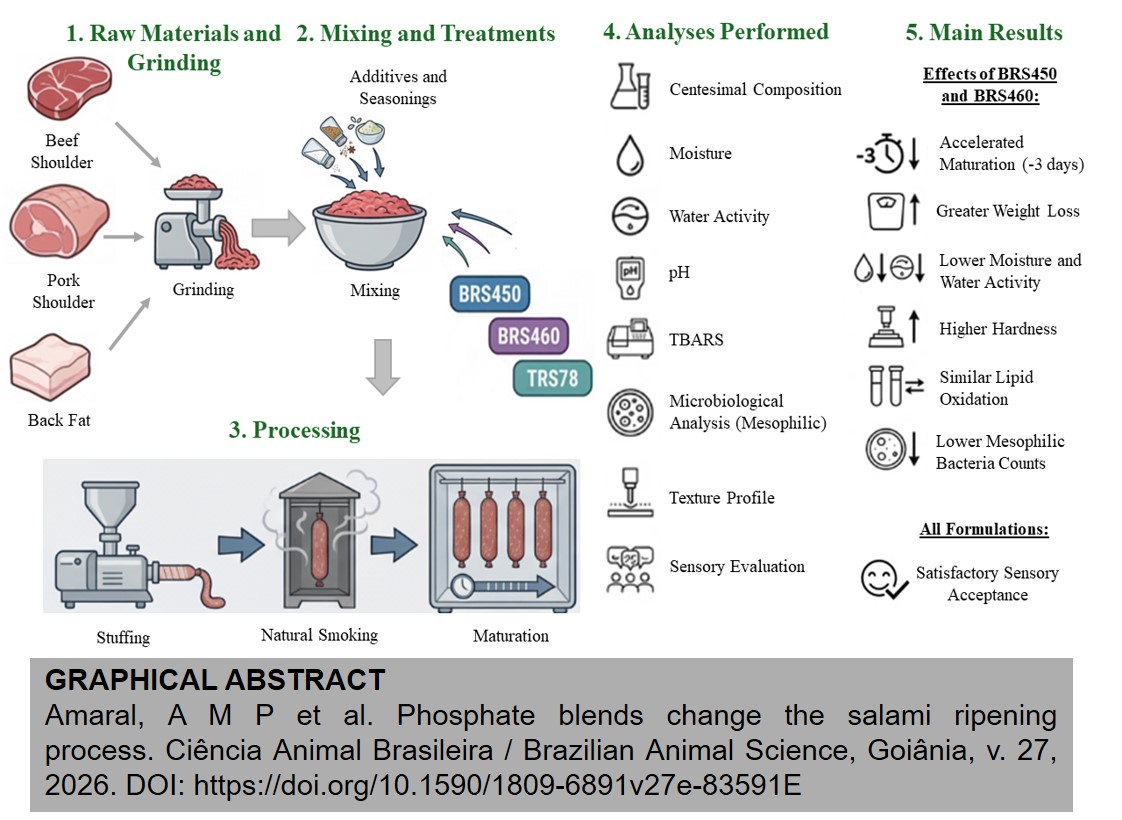
This study evaluated the effects of three phosphate blends on the ripening process of dry fermented sausages (salami) in comparison with a phosphate-free control by assessing physicochemical, microbiological, and sensory characteristics. The alkaline phosphate blends (BRS450 and BRS460) were more effective in accelerating ripening by three days compared with the control, as indicated by greater weight loss and lower moisture content and water activity; however, the reduction in pH occurred more slowly. These formulations also resulted in sausages with higher hardness due to the lower final moisture content, similar levels of lipid oxidation, and reduced mesophilic bacteria counts. The samples exhibited satisfactory sensory acceptance (scores > 7) for color, appearance, aroma, flavor, and texture. Overall, the results indicate that phosphate blends represent an effective technological strategy to accelerate salami ripening without impairing product quality, contributing to shorter processing times and potential economic benefits.
Keywords: Dry fermented sausage; weight loss; moisture; sensory acceptance.
Downloads
References
1. Bis-Souza CV, Penna ALB, da Silva Barretto AC. Applicability of potentially probiotic Lactobacillus casei in low-fat Italian type salami with added fructooligosaccharides: in vitro screening and technological evaluation. Meat Sci. 2020;168:108186. https://doi.org/10.1016/j.meatsci.2020.108186
2. Mohamed HMH, Burroughs S, Emch AW, Waite-Cusic J. Enhancing the reduction of Salmonella and Listeria monocytogenes during traditional salami processing by adding a finishing phase. Food Control. 2022;131:108432. https://doi.org/10.1016/j.foodcont.2021.108432
3. Tabanelli G, Barbieri F, Soglia F, Magnani R, Gardini G, Petracci M, et al. Safety and technological issues of dry fermented sausages produced without nitrate and nitrite. Food Res Int. 2022;160:111685. https://doi.org/10.1016/j.foodres.2022.111685
4. Thangavelu KP, Kerry JP, Tiwari BK, McDonnell CK. Novel processing technologies and ingredient strategies for the reduction of phosphate additives in processed meat. Trends Food Sci. Technol. 2019; 94:43–53. https://doi.org/10.1016/j.tifs.2019.10.001
5. Long NHBS, Gál R, Buňka F. Use of phosphates in meat products. Afr. J. Biotechnol. 2011;10:19874–19882. https://doi.org/10.5897/AJBX11.023
6. Pinton MB, Correa LP, Facchi MMX, Heck RT, Leães YSV, Cichoski AJ, et al. Ultrasound: A new approach to reduce phosphate content of meat emulsions. Meat Sci. 2019;152:88–95. https://doi.org/10.1016/j.meatsci.2019.02.010
7. Cao C, Yuan D, Li X, Kong B, Chen Q, Sun F, et al. Reduction of phosphate content in frankfurters by up to 50 % using micronized cold-pressed sesame seed cake. Meat Sci. 2022;185:108708. https://doi.org/10.1016/j.meatsci.2021.108708
8. Fonseca B, Kuri V, Zumalacárregui JM, Fernández-Diez A, Salvá BK, Caro I, et al. Effect of the use of a commercial phosphate mixture on selected quality characteristics of 2 Spanish-style dry-ripened sausages. J Food Sci. 2011;76(5):S300–S305. https://doi.org/10.1111/j.1750-3841.2011.02199.x
9. de Lima Alves L, Stefanello da Silva M, Martins Flores DR, Rodrigues Athayde D, Roggia Ruviaro A, da Silva Brum D, et al. Effect of ultrasound on the physicochemical and microbiological characteristics of Italian salami. Food Res Int. 2018;106:363–373. https://doi.org/10.1016/j.foodres.2017.12.074
10. AOAC. Official methods of analysis of AOAC International. 20th ed. Washington, DC: Association of Official Analytical Chemists; 2016.
11. Jo C, Ahn DU. Fluorometric analysis of 2-thiobarbituric acid reactive substances in turkey. Poult Sci. 1998;77(3):475–480. https://doi.org/10.1093/ps/77.3.475
12. Matos RA, Menezes CM, Ramos EM, Ramos ADLS, Gomide LADM. Efeito do tipo de fermentação na qualidade final de embutidos fermentados cozidos elaborados à base de carne ovina. Bol Cent Pesqui Process Alim. 2007;25(2). https://doi.org/10.5380/cep.v25i2.10610
13. Brasil. Ministério da Agricultura, Pecuária e Abastecimento. Instrução Normativa nº 30, de 26 de junho de 2018. Estabelece como oficiais os métodos constantes do Manual de Métodos Oficiais para Análise de Alimentos de Origem Animal. [Internet]. Available at: https://sistemasweb.agricultura.gov.br/sislegis/action/detalhaAto.do?method=gravarAtoPDF&tipo=INM&numeroAto=00000030&seqAto=000&valorAno=2018&orgao=GM/MAPA&codTipo=&desItem=&desItemFim
14. Brasil. Ministério da Agricultura, Pecuária e Abastecimento. Instrução Normativa nº 22, de 31 de julho de 2000. Aprova os Regulamentos Técnicos de Identidade e Qualidade de Copa, de Presunto tipo Parma, de Presunto Cru, de Salame, de Salaminho, de Salame tipo Alemão, de Salame tipo Calabrês, de Salame tipo Friolano, de Salame tipo Napolitano, de Salame tipo Hamburguês, de Salame tipo Italiano, de Salame tipo Milano, de Linguiça Colonial e Pepperoni. [Internet]. Available at: https://sistemasweb.agricultura.gov.br/sislegis/action/detalhaAto.do?method=gravarAtoPDF&tipo=INM&numeroAto=00000022&seqAto=000&valorAno=2000&orgao=SDA/MAA&codTipo=&desItem=&desItemFim
15. Ozaki MM, Munekata PES, Jacinto-Valderrama RA, Efraim P, Pateiro M, Lorenzo JM, et al. Beetroot and radish powders as natural nitrite source for fermented dry sausages. Meat Sci. 2021;171:108275. https://doi.org/10.1016/j.meatsci.2020.108275
16. Huang J, Bakry AM, Zeng S, Xiong S, Yin T, You J, et al. Effect of phosphates on gelling characteristics and water mobility of myofibrillar protein from grass carp (Ctenopharyngodon idellus). Food Chem. 2019;272:84–92. https://doi.org/10.1016/j.foodchem.2018.08.028
17. Lee J, Park HW, Jenkins R, Yoon WBB, Park JW. Image and chemical analyses of freezing-induced aggregates of fish natural actomyosin as affected by various phosphate compounds. Food Biosci. 2017;19:57–64. https://doi.org/10.1016/j.fbio.2017.06.007
18. Jia D, Huang Q, Xiong S. Chemical interactions and gel properties of black carp actomyosin affected by MTGase and their relationships. Food Chem. 2016;196:1180–1187. https://doi.org/10.1016/j.foodchem.2015.10.030
19. Hu Y, Zhang L, Yi Y, Solangi I, Zan L, Zhu J. Effects of sodium hexametaphosphate, sodium tripolyphosphate and sodium pyrophosphate on the ultrastructure of beef myofibrillar proteins investigated with atomic force microscopy. Chem., 2021;338:128146. https://doi.org/10.1016/j.foodchem.2020.128146
20. Vedovatto E, Steffens C, Cansian RL, Backes GT, Verlindo R. Evaluation of different starters cultures in the obtention of Italian-type sausage. Cienc Anim Bras. 2019;20:e47777. https://doi.org/10.1590/1809-6891v20e-47777
21. Delgado-Pando G, Fischer E, Allen P, Kerry JP, O’Sullivan MG, Hamill RM. Salt content and minimum acceptable levels in whole-muscle cured meat products. Meat Sci. 2018;139:179–186. https://doi.org/10.1016/j.meatsci.2018.01.025
22. De Prados M, García-Pérez JV, Benedito J. Non-destructive salt content prediction in brined pork meat using ultrasound technology. J Food Eng. 2015;154:39–48. https://doi.org/10.1016/j.jfoodeng.2014.12.024
23. Nguyen MV, Arason S, Thorarinsdottir KA, Thorkelsson G, Gudmundsdóttir A. Influence of salt concentration on the salting kinetics of cod loin (Gadus morhua) during brine salting. J Food Eng. 2010;100:225–231. https://doi.org/10.1016/j.jfoodeng.2010.04.003
24. Martín-Miguélez JM, Olegario LS, González-Mohino A, Ventanas S, Delgado J. Physicochemical, sensory, and safety evaluation of dry-cured fermented sausages and their plant-based analogs. LWT–Food Sci. Technol. 2024;208:116704. https://doi.org/10.1016/j.lwt.2024.116704
25. Susilo A, Widyastuti ES, Evanuarini H, Apriliyani MW. Comparison of the quality of fermented sausages with the use of yogurt starter and Lactobacillus plantarum (pH, aw, and proximate values). J. Penelit. Pendidik. IPA. 2023;9(5):2319–2324. https://doi.org/10.29303/jppipa.v9i5.2463
26. Molina RE, Bohrer BM, Mejia SMV. Phosphate alternatives for meat processing and challenges for the industry: A critical review. Food Res Int. 2023;166:112624. https://doi.org/10.1016/j.foodres.2023.112624
27. Kim YJ, Kim TK, Yun HJ, Kim J, Cha JY, Lee JH, et al. Effects of grafted myofibrillar protein as a phosphate replacer in brined pork loin. Meat Sci. 2023;199:109142. https://doi.org/10.1016/j.meatsci.2023.109142
28. Herrero AM, Ordóñez JA, de Avila R, Herranz B, de la Hoz L, Cambero MI. Breaking strength of dry fermented sausages and their correlation with texture profile analysis (TPA) and physico-chemical characteristics. Meat Sci. 2007;77:331-338. https://doi.org/10.1016/j.meatsci.2007.03.022
29. González-Fernández C, Santos EM, Rovira J, Jaime I. The effect of sugar concentration and starter culture on instrumental and sensory textural properties of chorizo-Spanish dry-cured sausage. Meat Sci. 2006;74:46-475. https://doi.org/10.1016/j.meatsci.2006.04.019
30. Zhang Y, Zheng S, Huang D, Xu B. Shaping microbial communities and flavor profiles: Effects of native Staphylococcus carnosus and Staphylococcus piscifermentans starter cultures in Chinese dry-fermented sausages. Food Res Int. 2026;226:118237. https://doi.org/10.1016/j.foodres.2025.118237
31. Li D, Du Y, Su L, Lin Y, Zheng J, Toldrá F, Zhu C, Du M, Liu Y, Chen J. Evaluation of the lipolytic and antioxidant activities of different strains of coagulase-negative staphylococci in fermented sausages. Meat Sci. 2025;230:109932. https://doi.org/10.1016/j.meatsci.2025.109932
32. Brasil. Agência Nacional de Vigilância Sanitária. Instrução Normativa nº 161, de 1 de julho de 2022. Estabelece os padrões microbiológicos dos alimentos. [Internet]. Available at: https://anvisalegis.datalegis.net/action/ActionDatalegis.php?acao=abrirTextoAto&link=S&tipo=INM&numeroAto=00000161&seqAto=000&valorAno=2022&orgao=ANVISA/MS&codTipo=&desItem=&desItemFim=&cod_modulo=134&cod_menu=1696
Downloads
Additional Files
Published
How to Cite
Issue
Section
License
Copyright (c) 2026 Brazilian Animal Science/ Ciência Animal Brasileira

This work is licensed under a Creative Commons Attribution 4.0 International License.
Authors who publish with this journal agree to the following terms:
- Authors retain copyright and grant the journal right of first publication with the work simultaneously licensed under a Creative Commons Attribution License that allows others to share the work with an acknowledgement of the work's authorship and initial publication in this journal.
- Authors are able to enter into separate, additional contractual arrangements for the non-exclusive distribution of the journal's published version of the work (e.g., post it to an institutional repository or publish it in a book), with an acknowledgement of its initial publication in this journal.
- Authors are permitted and encouraged to post their work online (e.g. in institutional repositories or on their website) prior to and during the submission process, as it can lead to productive exchanges, as well as earlier and greater citation of published work (See The Effect of Open Access).
Data statement
-
The research data is available on demand, condition justified in the manuscript