
Radiographic patterns and positioning recommendations for skull radiology in the brown brocket, Subulo gouazoubira (Fischer,1814)
Abstract
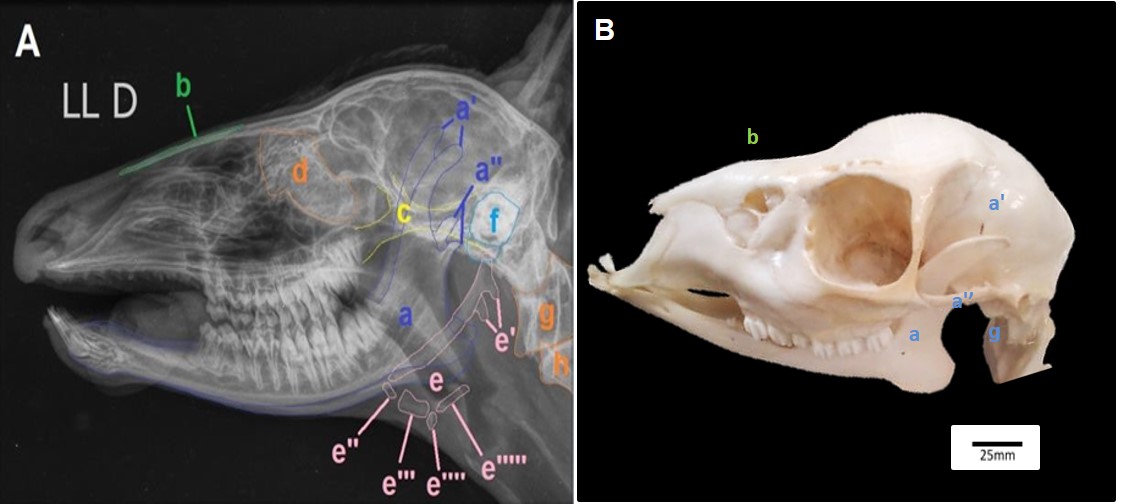
Incidents related to human activities, such as roadkill and illegal hunting, result in a high number of small deer being referred to triage and rehabilitation centers in Brazil, with multiple fractures being the most common injuries. Rapid and standardized radiographic diagnosis is essential for the emergency management of these animals. This study evaluated the most efficient radiographic projections for examining the cranial structures of the brown brocket deer (Subulo gouazoubira), using heads of eight individuals that died during the rehabilitation process at Wildlife Rehabilitation Center (Wildlife Rehabilitation Center) and which, after radiographic analysis procedures, were osteologically prepared for comparison. The most suitable projections proved to be the lateral, lateral with natural obliquity, dorsoventral, and rostrocaudal views, with the ventrodorsal view at 20° with 45° ventroflexion indicated as complementary for evaluating the tympanic bulla. The results highlight the importance of specific positioning protocols for accurate visualization of the nasal cavity, paranasal sinuses, and tympanic bullae. This study establishes, for the first time, a standardized emergency radiographic protocol for cervids with suspected cranial trauma, contributing to faster diagnoses and more assertive clinical decisions in rehabilitation centers.
Keywords: cervid; diagnostic imaging; head.
Downloads
References
1. Duarte JMB, Reis ML. Plano de ação nacional para conservação dos cervídeos ameaçados de extinção. Brasília: Instituto Chico Mendes de Conservação da Biodversidade. 2012; 126.
2. Rossi RV, Bodmer R, Duarte JMB. et al. Amazonian brown brocket deer Mazama nemorivaga (Cuvier,1817). Neotropical Cervidology, Biology and Medicine of Latin American Deer. Funep/IUCN. 2010; 393.
3. Black-Décima PA. Brown Brocket Deer Mazama gouazoubira (Fisher 1814) Neotropical cervidology: biology and medicine of Latin America deer. 2010; 190-201.
4. Black-Decima PA, Vogliotti A. Mazama gouazoubira . Lista vermelha de espécies ameaçadas da IUCN. 2016; Available at: https://bibliotecadigital.ufrgs.br/bitstream/handle/10183/283242/001194883.pdf?sequence=1&isAllowed=y
5. Bergallo HG, Rocha CFD, Alves MAS. et al. A fauna Ameaçada de extinção no Estado do Rio de Janeiro. EDURJ. 2000; 66.
6. Fontana CS, Bencke GAR. Livro vermelho da fauna ameaçada de extinção no Rio Grande do Sul. EDIPUCRS. 2003; 632.
7. Mikich SB, Bérnil SRS. Livro Vermelho da fauna ameaçada no Estado do Paraná. Instituto Ambiental do Paraná. 2004; 763.
8. Duarte JMB. et al. Avaliação do risco de Extinção do Veado-catingueiro Mazama gouazoubira (Fischer 1814), no Brasil. Biodiversidade Brasileira, 2012; 2 (3): 50-58. https://doi.org/10.37002/biodiversidadebrasileira.v2i1.238
9. Nisbet HO. et al. Treatment results of traumatic injuries in 20 Roe Deer (Capreolus capreolus): a retrospective study. Kafkas Universitesi Veteriner Fakultesi Dergisi, 2010; 16 (4):17-622. https://vetdergikafkas.org/uploads/pdf/pdf_KVFD_700.pdf
10. Kaneps JA. Orthopedic conditions of small ruminants: llama, sheep, goat, and deer. Veterinary Clinics of North America: Food Animal Practice, Advances in Ruminant Orthopedics, Philadelphia, 1996; 12 (1): 211-232. https://doi.org/10.1016/S0749-0720(15)30444-8
11.Reeder DM, Kramer KM. Stress in Free-Ranging Mammals: IntegratingPhysiology, Ecology, and Natural History. Journal of Mammalogy. 2005; 86 (2). Available at: https://doi.org/10.1644/BHE-003.1
12. Mannheim J. et al. Standardization of Small Animal Imaging—Current Status and Future Prospects. Molecular Imaging and Biology. 2017; 20. 1-16. Available at: https://doi.org/10.1007/s11307-017-1126-2
13. Taube MJ. et al. Heart measurements of non-human primates by radiographic techniques. Ciência Animal Brasileira. 2019; 20. Available at: https://doi.org/10.1590/1089- 6891v20e-52786
14. Willians J. Orthopedic radiography in exotic animal practice. Vet. Clin. North Am. Exot. Anim. Pract. 2002; 1. 43-44. Available at: https://doi.org/10.1016/S1094-9194(03)00043-4
15. Souza RAM. Determinação da idade e biologia reprodutiva de Mazama rafinesque, 1817 (Artiodactyla, Cervidae) [Tese] [Internet]. Paraná: - Universidade Federal do Paraná; 2019. [acesso em 2018 nov 12]. Available at: https://hdl.handle.net/1884/61888
16. Souza JP. et al. Osteología del Miembro Torácico de la Corzuela Parda Mazama gouazoubira (G. Fischer, 1814) (Cetartiodactyla: Cervidae). International Journal of Morphology. 2017; 35 (3): 22-89. http://dx.doi.org/10.4067/S0717-95022017000300031
17. Silva GM, Stipp ACM, Oliveira, LR. et al. Descriptive skull morphology of Subulo gouazoubira and Mazama nana (Artiodactyla, Cervidae). Ciência Rural, Santa Maria. 2025; 55 (2): https://doi.org/10.1590/0103-8478cr20230692
18. Schimming BC. et al. Osteology and radiographic anatomy of the hind limbs in Marsh deer (Blastocerusdichotomus). PesquisaVeterinária Brasileira. 2015; 35 (12): 997-1001. https://doi.org/10.1590/S0100-736X2015001200009
19. Thrall DE. Diagnóstico de Radiologia Veterinária. 2019; 7. 01-1000. https://app.minhabiblioteca.com.br/books/9788595150515
20. International committee on veterinary gross anatomical nomenclature (icvgan). Terminologia anatômica: Nomina anatômica veterinária. Rio de Janeiro: Interamericana; 2017.
21. Baroni CO. et al. Morphology and morphometry of the foramen magnum in Toy Poodle and Yorkshire terrier dogs. Ciência Rural. 2011; 41 (7): 1239-1244. https://doi.org/10.1590/S0103-84782011000700021
22. Keneisenuo OP. et al. A comparative study on the morphology, radiography and computed tomography of the skull bones of barking deer (Muntiacus muntjak) and sambar deer (Rusa unicolor). Folia Morphologica. 2021. Available at: https://doi.org/10.5603/FM.a2021.0015
23. Choudhary OP, Singh I. Morphogical and radiographic studies on the skull of Indian blackbuck (Antilope cervicapra). Int. J. Morphol. 2016; 16(2): 775–783. Available at: http://dx.doi.org/10.4067/S0717-95022020000501473
Downloads
Published
How to Cite
Issue
Section
License
Copyright (c) 2026 Brazilian Animal Science/ Ciência Animal Brasileira

This work is licensed under a Creative Commons Attribution 4.0 International License.
Authors who publish with this journal agree to the following terms:
- Authors retain copyright and grant the journal right of first publication with the work simultaneously licensed under a Creative Commons Attribution License that allows others to share the work with an acknowledgement of the work's authorship and initial publication in this journal.
- Authors are able to enter into separate, additional contractual arrangements for the non-exclusive distribution of the journal's published version of the work (e.g., post it to an institutional repository or publish it in a book), with an acknowledgement of its initial publication in this journal.
- Authors are permitted and encouraged to post their work online (e.g. in institutional repositories or on their website) prior to and during the submission process, as it can lead to productive exchanges, as well as earlier and greater citation of published work (See The Effect of Open Access).
Data statement
-
The research data is available on demand, condition justified in the manuscript