
Clinical and bacteriological diagnosis of infectious keratoconjunctivitis in ruminants from herds in the state of Maranhão, Brazil
DOI:
https://doi.org/10.1590/1809-6891v27e-81424EAbstract
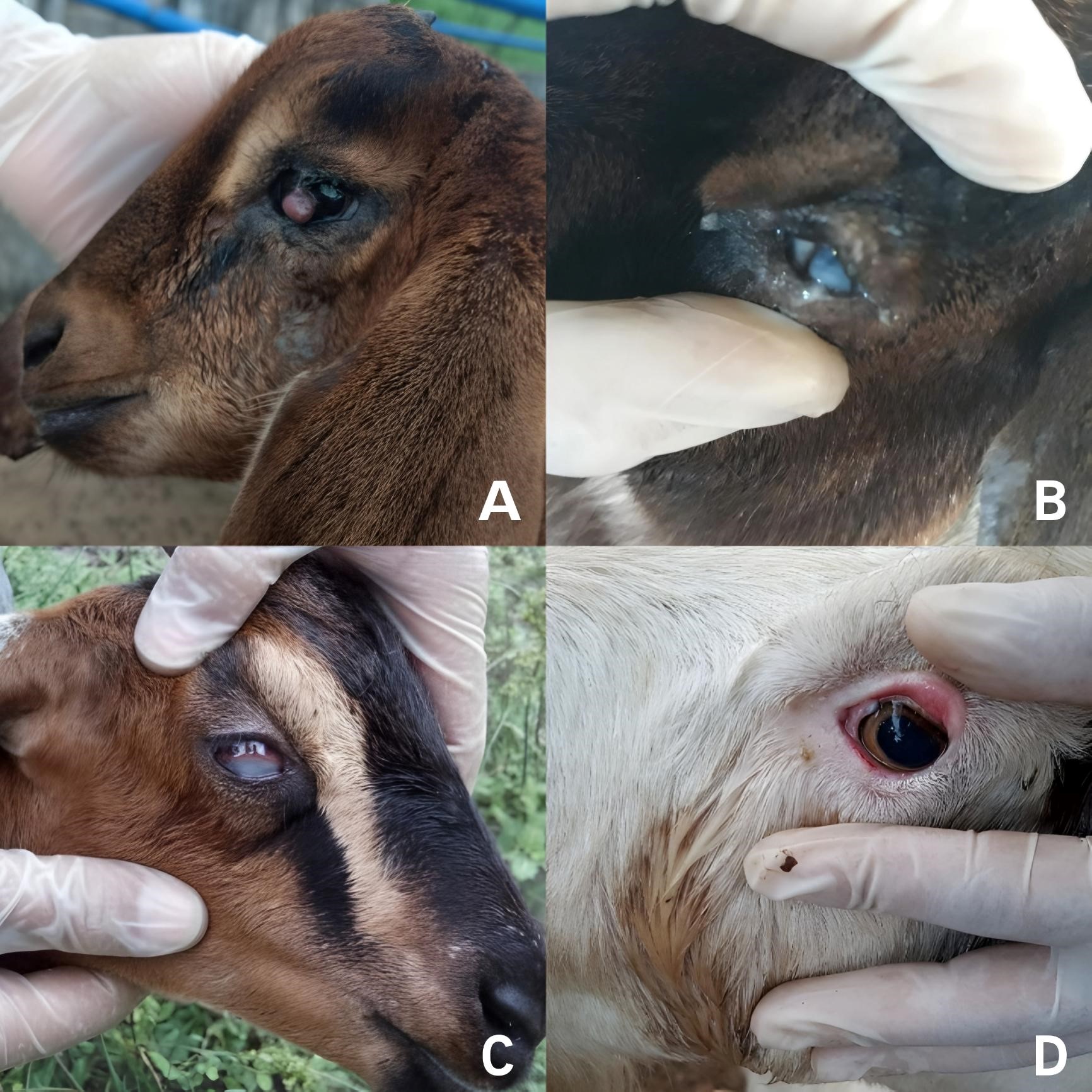
Infectious keratoconjunctivitis, caused mainly by Moraxella spp., is a common disease in ruminants such as cattle, goats and sheep, manifested by ocular signs such as conjunctival hyperemia, epiphora and corneal opacity, which can lead to blindness. Transmission occurs by direct contact, aerosols, fomites and mechanical vectors such as flies. This study aimed to diagnose and provide data on the occurrence of infectious keratoconjunctivitis in herds of Maranhão. A total of 5814 animals (4348 goats, 1426 sheep and 40 cattle) were evaluated, of which 16 presented clinical signs of keratoconjunctivitis. The highest prevalence was observed in cattle (5 %, n=2), followed by sheep (0.56 %, n=8) and goats (0.13 %, n=6). Most of the affected goats were less than one year old (83.33 %), and among sheep, the Santa Ines breed was the most affected (62.5 %). Among cattle, both affected animals were females of the Holstein breed. The clinical signs observed were consistent between species, including corneal opacity, lacrimation and purulent discharge. Microbiological analysis confirmed Moraxella spp. in 7 samples (3 goats, 2 sheep, 2 cattle), confirming it as the probable cause. Five samples were contaminated and three showed no bacterial growth. The lack of biosecurity measures, such as vector control and quarantine, may have contributed to the spread of the disease. This study, the first of its kind in the region, highlights the urgent need for preventive measures and more effective diagnostic strategies in Maranhão, as well as the need for research to improve the clinical and epidemiological understanding of this disease.
Keywords: Moraxella spp.; veterinary ophthalmology; goats; sheep; cattle.
Downloads
References
1. Kneipp M. Defining and Diagnosing Infectious Bovine Keratoconjunctivitis. Veterinary Clinics of North America: Food Animal Practice [Internet]. 2021 [cited 2024 Dec 10];37(2):237–252. Available from: https://doi.org/10.1016/j.cvfa.2021.03.001
2. Jayasekara PP, Jenkins C, Gerber PF, Olmo L, Xaikhue T, Theppangna W, Walkden-Brown SW. Case-control study to identify the causative agents of ophthalmia and conjunctivitis in goats in Savannakhet province of Lao PDR. Veterinary Microbiology [Internet]. 2024 [cited 2024 Dec 10];296:110195. Available from: https://doi.org/10.1016/j.vetmic.2024.110195
3. Bilbao L, Acquistapace S, Umpiérrez A, Smircich P, Alonzo P, Sotelo-Silveira JR, Zunino P. Genomic characterization of Moraxella bovis and Moraxella bovoculi Uruguayan strains isolated from calves with infectious bovine keratoconjunctivitis. Revista Argentina de Microbiologia [Internet]. 2024 [cited 2024 Dec 9];56(2):165–174. Available from: https://doi.org/10.1016/j.ram.2023.12.003
4. Gulaydin A, Gulaydin O, Akgul MB, Sindak N, Yildirim O. Investigation of the presence of Chlamydia spp., Mycoplasma spp., and Moraxella ovis in infectious keratoconjunctivitis cases in sheep and goats in Siirt province and evaluation of clinical findings. Polish Journal of Veterinary Sciences [Internet]. 2024 [cited 2024 Dec 10];183–191. Available from: https://doi.org/10.24425/pjvs.2024.149348
5. Angelos, JA. Infectious Bovine Keratoconjunctivitis (Pinkeye). Veterinary Clinics of North America: Food Animal Practice [Internet]. 2015 [cited 2024 Dec 10];31(1):61–79. Available from: https://doi.org/10.1016/j.cvfa.2014.11.006
6. Maier, G, Doan, B, O’Connor, AM. The Role of Environmental Factors in the Epidemiology of Infectious Bovine Keratoconjunctivitis. Veterinary Clinics of North America: Food Animal Practice [Internet]. 2021 [cited 2024 Dec 10];37(2):309–320. Available from: https://doi.org/10.1016/j.cvfa.2021.03.006
7. Angelos JA, Elizalde P, Griebel P. Bovine Immune Responses to Moraxella bovis and Moraxella bovoculi Following Vaccination and Natural or Experimental Infections. Veterinary Clinics of North America: Food Animal Practice [Internet]. 2021 [cited 2024 Dec 10];37(2):253–266. Available from: https://doi.org/10.1016/j.cvfa.2021.03.002
8. Hadi NS, Jaber NN, Sayhood MH, Mansour FT. Isolation and genetic detection of Moraxella bovis from bovine keratoconjunctivitis in Basrah city. Iraqi Journal of Agricultural Science [Internet]. 2021 [cited 2024 Dec 10];52(4):925–931. Available from: https://doi.org/10.36103/ijas.v52i4.1401
9. Kalaiselvi G, Balakrishnan G, Raman A, Jayanthi N, Ramya R, Soundararajan C. Molecular Confirmation of Moraxella bovis Associated Infectious Keratoconjunctivitis in Ruminants. Indian Journal of Animal Research [Internet]. 2024 [cited 2024 Dec 13]; Available from: https://doi.org/10.18805/IJAR.B-5349
10. Soares DM, Alves MS, Barros TM, Policarpo WA, Rocha TB, Campos NRCL, Pereira H de M. Isolamento e Identificação Molecular de Corynebacterium pseudotuberculosis em Caprinos e Ovinos com Linfadenite. Revista Ciência Animal [Internet]. 2024 Apr 12 [cited 2024 Dec 13];34(1):71–80. Available from: https://revistas.uece.br/index.php/cienciaanimal/article/view/12861
11. El-Khabaz KAS, Zaitoun AMA, Elseleny MGA. Clinical study on Moraxella-associated infectious keratoconjunctivitis (IKC) of small ruminants. Benha Veterinary Medical Journal [Internet]. 2021 [cited 2024 Dec 13];40:1–4. Available from: https://doi.org/10.21608/bvmj.2021.80682.1436
12. Carmo P, Vargas AC, Rissi DR, Oliveira-Filho JC, Pierezan F, Lucena RB, Leivas Leite FL, Barros CSL. Surto de ceraconjuntivite infecciosa bovina e hemoncose causando mortalidade em bezerros. Pesquisa Veterinária Brasileira [Internet]. 2011 [cited 2024 Dec 13];31(5):374–378. Available from: https://doi.org/10.1590/S0100-736X2011000500002
13. Chaves NST, Lima AMV, Amaral AVC. Surto de ceratoconjuntivite infecciosa em ovinos causada por Moraxella spp. no Estado de Goiás, Brasil. Ciência Animal Brasileira [Internet]. 2008 [cited 2024 Dec 13];9(1):256–261. Available from: https://revistas.ufg.br/vet/article/view/3695
Published
How to Cite
Issue
Section
License
Copyright (c) 2025 Brazilian Animal Science/ Ciência Animal Brasileira

This work is licensed under a Creative Commons Attribution 4.0 International License.
Authors who publish with this journal agree to the following terms:
- Authors retain copyright and grant the journal right of first publication with the work simultaneously licensed under a Creative Commons Attribution License that allows others to share the work with an acknowledgement of the work's authorship and initial publication in this journal.
- Authors are able to enter into separate, additional contractual arrangements for the non-exclusive distribution of the journal's published version of the work (e.g., post it to an institutional repository or publish it in a book), with an acknowledgement of its initial publication in this journal.
- Authors are permitted and encouraged to post their work online (e.g. in institutional repositories or on their website) prior to and during the submission process, as it can lead to productive exchanges, as well as earlier and greater citation of published work (See The Effect of Open Access).




Data statement
-
The research data is available on demand, condition justified in the manuscript