
Glycemia and lactacidemia in eventing horses in a high-speed treadmill test
DOI:
https://doi.org/10.1590/1809-6891v26e-80876EAbstract
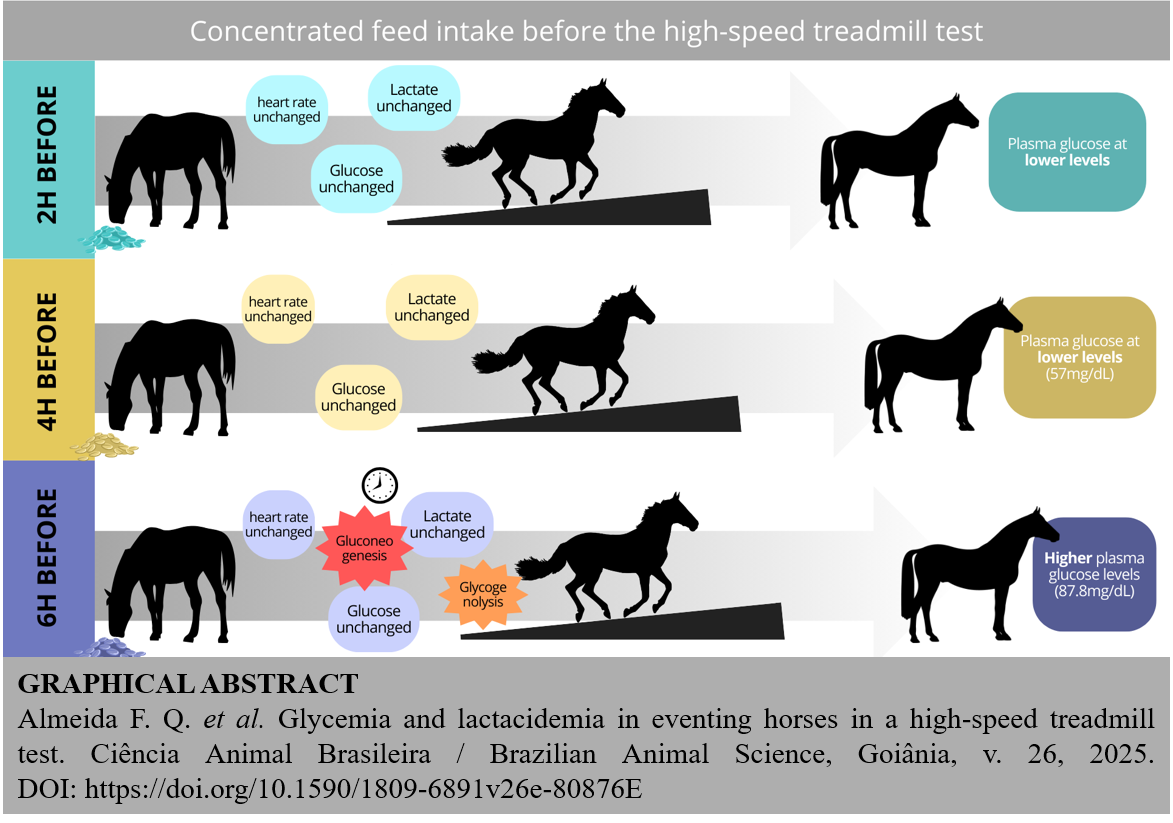
This study aimed to evaluate the effects on glycemia and lactacidemia as a function of the time of intake of concentrate ration in horses before a high-speed treadmill test. Fifteen eventing Brazilian Sport horses were used in two experimental trials in a completely randomized design. In the first trial, a glycemic index test was performed with four horses and the glycemic response was evaluated after concentrate ration intake. In the second trial, 12 horses were used, in three experimental treatments (time of supply of concentrate ration before the high-speed treadmill test - 2, 4 and 6h) and four horses / group, and submitted to test on a treadmill. Blood samples were collected for glucose, lactate and heart rate monitoring and, with these results, VL2, VL4 and V200 were estimated by exponential and linear regression, respectively. The evaluating of horse’s performance in the experimental groups it was verified that VL2, VL4, and V200 were not influenced by the time of supply of the concentrate ration in 2, 4 or 6 hours before the high-speed treadmill test. The time of supply of the concentrate ration before the high-speed treadmill test did not influence the glycemia, lactacidemia and heart rate of the horses before and during the test. Further studies are needed to understand the glucose restoration after exercise in standardized treadmill speed tests.
Downloads
References
Evans DL. Exercise testing in the field. In: Hinchcliff KW, Kaneps AJ, Geor RJ, editors. Equine Sports Medicine and Surgery. 1st ed. London: Saunders; 2004. p. 19-31. ISBN: 978-0-7020-2857-1
Hines MT. Clinical approach to commonly encountered problems. In: Reed SM, Bayly WM, Sellon DC, editors. Equine Internal Medicine. 4th ed. Amsterdam: Elsevier Health Sciences; 2017. p. 232-310. PMCID: PMC7158300
Castejón F, Riber C, Santisteban R, Tovar P, Trigo P, Agüera Y. Valoración ergométrica y muscular en cinta rolante. In: Valoración morfofuncional en el plan de mejora del pura raza español-caballo andaluz. Junta de Andalucía, Ministerio de Educación y Cultura; 1995. p. 100-12. ISBN: 978-84-92521-89-0
Nankervis EJ, Launder RCM, Murray RC. The Use of Treadmills Within the Rehabilitation of Horses. J Equine Vet Sci. 2017; 53:108-15. DOI: https://doi.org/10.1016/j.jevs.2017.01.010
Souza BG, Veiga CCP, Oliveira GF, Ferreira AMR, Almeida FQ. Avaliação de um programa de treinamento para cavalos de concurso completo de equitação: efeitos sobre a frequência cardíaca e a curva de lactato. Rev Bras Med Vet. 2013; 35(4):385-91. Disponível em: https://bjvm.org.br/BJVM/article/view/623
Muñoz A, Santisteban R, Rubio MD, Vivo R, Agüera EI, Escribano BM, et al. The use of functional indexes to evaluate fitness in the Andalusian horse. J Vet Med Sci. 1997; 59(9):747-52. DOI: https://doi.org/10.1292/jvms.59.747
Hodgson DR, McGowan CM. An Overview of Performance and Sports Medicine. In: Hodgson DR, McGowan CM, McKeever KH, editors. The Athletic Horse: Principles and Practice of Equine Sports Medicine. 2nd ed. Elsevier Saunders; 2014. p. 1-8. DOI: https://doi.org/10.1016/B978-0-7216-0075-8.00010-1
De Mare L. Standardized exercise tests in horses: current situation and future perspectives. Vlaams Diergen Tijdschr. 2017; 86(2):63-72. DOI: https://doi.org/10.21825/vdt.v86i2.16290
Gobesso AAO, Etchichury M, Tosi H. Resposta plasmática de glicose e insulina em equinos alimentados com diferentes fontes de amido. Braz J Vet Res Anim Sci. 2009; 46(4):324-31. URI: http://hdl.handle.net/11449/71450
Gleeson M. Biochemistry of Exercise. In: Micheli LJ, editor. The Encyclopaedia of Sports Medicine. 1st ed. Sage Publications, Inc; 2013. p. 36-58. DOI: https://doi.org/10.1002/9781118692318.ch3
Brøkner C, Austbø D, Næsset JA, Blache D, Knudsen KEB, Hansen HH, Tauson AH. Glycaemic and insulinemic response to dietary carbohydrates in horses. Acta Vet Scand. 2016; 58(Suppl 1):69. DOI: https://doi.org/10.1186/s13028-016-0244-1
Pagan JD, Harris PA. The effects of timing and amount of forage and grain on exercise response in thoroughbred horses. Equine Vet J. 1999; 30:451-7. DOI: https://doi.org/10.1111/j.2042-3306.1999.tb05264.x
Vervuert I, Voigt K, Hollands T, Cuddeford D, Coenen M. Effect of feeding increasing quantities of starch on glycaemic and insulinaemic responses in healthy horses. Vet J. 2009; 182:67-72. DOI: https://doi.org/10.1016/j.tvjl.2008.04.011
Jansson A, Lindberg E. A forage-only diet alters the metabolic response of horses in training. Anim. 2012; 6(12):1939-46. DOI: https://doi.org/10.1017/S1751731112000948
Oliveira CA, Azevedo JF, Miranda ACT, Souza BG, Ramos MT, Costa APD, et al. Hematological and blood gas parameters response to treadmill exercise test in eventing horses fed different protein levels. J Equine Vet Sci. 2014; 34(11-12):1279-85. DOI: https://doi.org/10.1016/j.jevs.2014.09.007
Jose-Cunilleras E, Hinchcliff KW, Lacombe VA, Sams RA, Kohn CW, Taylor LE, Devor ST, et al. Ingestion of starch-rich meals after exercise increases glucose kinetics but fails to enhance muscle glycogen replenishment in horses. Vet J. 2006; 171(3):468-77. DOI: https://doi.org/10.1016/j.tvjl.2005.02.002
Pagan JD, Burger I, Jackson SG. The long-term effects of feeding fat to 2-year-old Thoroughbreds in training. Equine Vet J. 1995; 18:281-8. DOI: https://doi.org/10.1111/j.2042-3306.1995.tb04949.x
Henneke DR, Potter GD, Krieder JL. Relationship between condition score, physical measurements and body fat percentage in mares. Equine Vet J. 1983; 15:371-2. DOI: https://doi.org/10.1111/j.2042-3306.1983.tb01826.x
National Research Council. Nutrients requirements of horses. 6th ed. Washington, DC: National Academy of Science; 2007. 341 p. DOI: https://doi.org/10.17226/11653
Pagan JD. Advances in Equine Nutrition. Nottingham: Nottingham University Press; 1998. p. 71-6. ISBN-13: 978-1897676837
Mircean M, Giurgiu G, Mircean V, Zinveliu E. Serum cortisol variation of sport horses in relation with the level of training and effort intensity. Bull USAMV-CN. 2007; 64:488-92. https://journals.usamvcluj.ro/index.php/veterinary/article/view/2481
Coelho CS, Gama JA, Lopes PF, Souza VR. Glicemia e concentrações séricas de insulina, triglicérides e cortisol em equinos da raça Mangalarga Marchador após exercício físico. Pesq Vet Bras. 2011; 31(9):756-60. DOI: https://doi.org/10.1590/s0100-736x2011000900006
Hansen TL, Rankins EM, Bobel JM, McKinney M, Hackmann TJ, Warren LK. Postprandial blood glucose and insulin responses of horses to feeds differing in soluble fiber concentration. J Equine Vet Sci. 2020; 88:102963. DOI: https://doi.org/10.1016/j.jevs.2020.102963
Healy HP, Siciliano PD, Lawrence LM. Effect of concentrate form on blood and gastric fluid variables in ponies. Equine Nutr Physiol Soc. 1995; 15(10):423-8. DOI: https://doi.org/10.1016/S0737-0806(06)81833-2
Kaneko JJ, Harvey JW, Bruss ML. Clinical biochemistry of domestic animals. 6th ed. New York: Academic Press; 2008. 928 p. DOI: https://doi.org/10.1016/B978-0-12-370491-7.00001-5
McGowan CM., Hodgson DR. Hematology and biochemistry. In: Hodgson DR, McKeever KH, McGowan CM. The Athletic Horse: Principles and Practice of Equine Sports Medicine. 2nd Edition. Elsevier Saunders. Missouri, USA. 2014. p. 56-68. ISBN: 978-0-7216-0075-8
Bertin FR, Taylor SD, Bianco AW, Sojka‐Kritchevsky JE. The effect of fasting duration on baseline blood glucose concentration, blood insulin concentration, glucose/insulin ratio, oral sugar test, and insulin response test results in horses. J Vet Intern Med. 2016; 30:1726-31. DOI: https://doi.org/10.1111/jvim.14529
Trilk JL, Lindner AJ, Greene HM, Alberghina D, Wickler SJ. A lactate-guided conditioning programme to improve endurance performance. Equine Vet J Suppl. 2002; 34:122-5. DOI: https://doi.org/10.1111/j.2042-3306.2002.tb05403.x
McKeever KH. The endocrine system and the challenge of exercise. Vet Clin North Am Equine Pract. 2002; 18:321-53. DOI: https://doi.org/10.1016/S0749-0739(02)00005-6
Ferraz GDC, Teixeira-Neto AR, Pereira MDC, Linardi RL, Lacerda-Neto JCD, Queiroz-Neto AD. Influência do treinamento aeróbio sobre o cortisol e glicose plasmáticos em equinos. Arq Bras Med Vet Zootec. 2010; 62(1):23-9. DOI: https://doi.org/10.1590/S0102-09352010000100003
Rose RJ, Ilkiw JE, Sampson D. Changes in blood gas: acid–base and metabolic parameters in horses during three-day event competition. Res Vet Sci. 1980; 28(3):393-8. DOI: https://doi.org/10.1016/S0034-5288(18)32733-4
Boffi F. Fisiología del Ejercicio en Equinos. 1st ed. Buenos Aires: Inter-Médica; 2007. 320p. ISBN: 978-9505553143
Prates RC, Rezende HHC, Lana AMQ, Borges I, Moss PCB, Moura RS, Rezende ASC. Heart rate of Mangalarga Marchador mares under marcha test and supplemented with chrome. Rev Bras Zootec. 2009; 38:916-22. DOI: https://doi.org/10.1590/S1516-35982009000500019
Garcia TR, Rezende ASCD, Santiago JM, Almeida FQD, Fonseca MG, Munõz A. Venous hemogasometry and blood electrolytes in Mangalarga Marchador mares submitted to aerobic training. Ciênc Agrotec. 2013; 37(6):559-65. DOI: https://doi.org/10.1590/S1413-70542013000600009
Kowal RJ, Almosny NRP, Cascardo B, Summa RP, Cury LJ. Avaliação dos valores de lactate e da atividade sérica da enzima creatina quinase em cavalos (Equus caballus) da raça Puro-Sangue-Inglês (PSI) submetidos a teste de esforço em esteira ergométrica. Rev Bras Ciênc Vet. 2006; 13(1):13-9. DOI: http://dx.doi.org/10.4322/rbcv.2014.259
Bayly W, et al. Equine Sport Medicine and Surgery: basic and clinical sciences of the equine athlete. 1st ed. Philadelphia: Saunders Company; 2004. p. 27-56. DOI: https://doi.org/10.1016/B978-0-7020-2671-3.50009-X
Seeherman HJ, Morris EA. Comparison of yearling, two-year-old and adult Thoroughbreds using a standardised exercise test. Equine Veterinary Journal, 1991; 23:175-184. DOI: https://doi.org/10.1111/j.2042-3306.1991.tb02750.x
Additional Files
Published
How to Cite
Issue
Section
License
Copyright (c) 2025 Brazilian Animal Science/ Ciência Animal Brasileira

This work is licensed under a Creative Commons Attribution 4.0 International License.
Authors who publish with this journal agree to the following terms:
- Authors retain copyright and grant the journal right of first publication with the work simultaneously licensed under a Creative Commons Attribution License that allows others to share the work with an acknowledgement of the work's authorship and initial publication in this journal.
- Authors are able to enter into separate, additional contractual arrangements for the non-exclusive distribution of the journal's published version of the work (e.g., post it to an institutional repository or publish it in a book), with an acknowledgement of its initial publication in this journal.
- Authors are permitted and encouraged to post their work online (e.g. in institutional repositories or on their website) prior to and during the submission process, as it can lead to productive exchanges, as well as earlier and greater citation of published work (See The Effect of Open Access).




Data statement
-
The research data is available on demand, condition justified in the manuscript