Cefalosporin resistance genes and antibacterial activity of Pereskia aculeata against ESBL- producing Escherichia coli isolated from broiler chickens
DOI:
https://doi.org/10.1590/1809-6891v26e-80467EAbstract
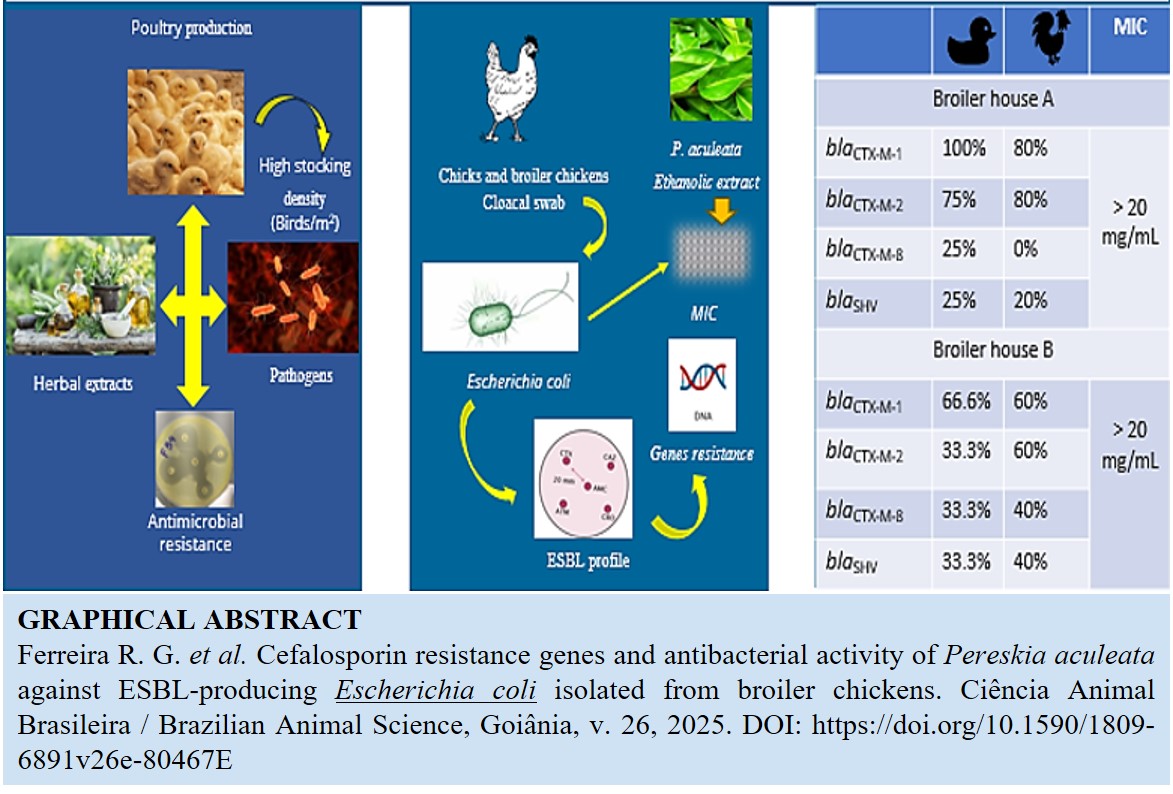
Antimicrobial resistance in Escherichia coli strains has contributed to the search for alternative antimicrobial products, such as plant extracts. The objective of this study was to evaluate the profile of cephalosporin-resistance genes in E. coli isolates with an extended-spectrum ß-lactamase (ESBL) production phenotype, and the phenolic composition and antibacterial activity of the ethanolic extract of Pereskia aculeata against strains isolated from 1-day-old and growing chickens. To determine the minimum inhibitory concentration (MIC) and minimum bactericidal concentration (MBC) of the ethanolic extract of P. aculeata, E. coli isolates that exhibited an ESBL profile when isolated from either 1-day-old chicks or growing chickens were selected. The resistance genes blaCTX-M-1, blaCTX-M-2, blaCTX-M-8, and blaSHV were detected in a higher percentage of isolates from growing chickens. The P. aculeata extract was found to contain several phenolic compounds, with malic acid and rutin being predominant. Determination of MIC was only possible for two E. coli isolates (one from Broiler house A (growing chickens) and the other from Broiler house B (1-day-old chicks) - and for the standard strain E. coli ATCC 25922; in all cases, the MIC was 20 mg/mL. These findings indicate that E. coli isolates from both age groups carried cephalosporin-resistance genes and exhibit similar susceptibility to the P. aculeata extract, regardless of ESBL phenotype. These results highlight the need for further research into plant-based antimicrobials.
Key-words: blaCTX-M-1; minimum inhibitory concentration; minimum bactericidal concentration; Ora-pro-nóbis.
Downloads
References
Sandi, A. J. Embrapa Suínos e Aves, dez. 2021 Available from: https://www.embrapa.br/agencia-de-informacao-tecnologica/criacoes/frango-de-corte/producao/gestao-unidade-produtora/desempenho-economico
Andrade L, Freitas ES. Efeitos da densidade populacional sobre o desempenho produtivo em frangos de corte em diferentes tipos de aviários. Arquivos Brasileiros de Medicina Veterinária FAG. 2018; 1(1): 185-192. Available from: https://themaetscientia.fag.edu.br/index.php/ABMVFAG/article/view/264
Dalólio FS, Moreira J, Valadares LR, Nunes PB, Vaz DP, Pereira HJ, Cruz PJ. Aditivos alternativos ao uso de antimicrobianos na alimentação de frangos de corte. Revista. Brasileira Agropecuária Sustentável. 2015; 5 (1): 86-94. Available from: http://dx.doi.org/10.21206/rbas.v5i1.281
Teillant A, Laxminarayan R. Economics of antibiotic use in US swine and poultry production. Choices. 2015; 30 (1): 1-11.
Lentz SAM. Atualização sobre uso racional de antimicrobianos e boas práticas de produção. Porto Alegre: OPAS/MAPA, 2022. 50p.
Maiorki KM, Fukumoto NM. (2021). Colibacilose aviária: revisão de literatura. Brazilian Journal of Development. 2021; 7 (10): 99696-99707. Available from: http://dx.doi.org/10.34117/bjdv7n10-332
Ibrahim RA, Cryer TL, Lafi SQ, Basha EA, Good L, Tarazi YH. Identification of Escherichia coli from broiler chickens in Jordan, their antimicrobial resistance, gene characterization, and the associated risk factors. BMC Veterinary Research. 2019; 15 (159): 1-16. Available from: http://dx.doi.org/10.1186/s12917-019-1901-1
Hu J, Afayibo DJA, Zhang B, Zhu H, Yao L, Guo W, Wang S. Characteristics, pathogenic mechanism, zoonotic potential, drug resistance, and prevention of avian pathogenic Escherichia coli (APEC). Frontiers Microbiology. 2022; 13: 1-10. Available from: http://dx.doi.org/10.3389/fmicb.2022.1049391
Kim YB, Yoon MY, Ha, JS, Seo KW, Noh EB, Son SH, Lee YJ. Molecular characterization of avian pathogenic Escherichia coli from broiler chickens with colibacillosis. Poultry Science. 2020; 99 (2): 1088-1095. Available from: http://dx.doi.org/10.1016/j.psj.2019.10.047
Tseng CH, Liu CW, Liu PY. Extended-Spectrum β-Lactamases (ESBL) producing bacteria in animals. Antibiotics. 2023; 12: 661. Available from: http://dx.doi.org/10.3390/antibiotics12040661
Santos LS, Queiroz CRAA, Melo CMT. Cactáceas do gênero Pereskia: composição nutricional e algumas aplicações. ForScience. 2021; 9 (2): e00702. Available from: http://dx.doi.org/10.29069/forscience.2021v9n2.e702
Agostini-Costa TS, Wondraceck DC, Rocha WDS, Silva DBD. Carotenoids profile and total polyphenols in fruits of Pereskia aculeata Miller. Revista Brasileira Fruticultura. 2012; 34(1): 234-238. Available from: http://dx.doi.org/10.1590/S0100-29452012000100031
Sousa RMF, Lira CS, Rodrigues AO, Morais SAL, Queiroz CRAA, Chang R, Aquino FJ, Muñoz RAA, Oliveira A. Atividade antioxidante de extratos de folhas de ora-pró-nóbis (Pereskia aculeata Mill.) usando métodos espectrofotométricos e voltamétricos in vitro. Bioscience. Journal. 2014; 30 (1): 448-457.
Pimenta PC, Belo TCA, Vanzele PAR, Nasser TF, Santos HCAS, Bani GMAC. Avaliação da capacidade antimicrobiana do óleo essencial de Pereskia aculeata: interação com microrganismos encontrados em jalecos de profissionais de saúde. Brazilian Journal of Development. 2020; 6 (6):40046-40058. Available from: https://doi.org/10.34117/bjdv6n6-514
Garcia JAA, Corrêa RCG, Barros L, Pereira C, Abreu RMV, Alves MJ, Calhelha RC, Bracht A, Peralta RM, Ferreira ICFR. Phytochemical profile and biological activities of 'Ora-pro-nobis' leaves (Pereskia aculeata Miller), an underexploited superfood from the Brazilian Atlantic Forest. Food Chemistry. 2019; 294: 302-309. Available from: http://dx.doi.org/10.1016/j.foodchem.2019.05.074
Moraes TV, De Souza MRA, Souza JL, Simão CBR, Moreira RFA. Potencial antioxidante da espécie Pereskia aculeata Miller: uma análise bibliométrica. Brazilian Journal of Surgery and Clinical Research. 2019; 29 (1): 79-85.
Agostini-Costa TS, Pêssoa GKA, Silva DB, Gomes IS, Silva JP. Carotenoid composition of berries and leaves from a Cactaceae–Pereskia sp. Journal of Functional Foods. 2014; 11: 178-184. Available from: http://dx.doi.org/10.1016/j.jff.2014.09.015
Quinn PJ, Markey BK, Carter ME, Donnelly WJ, Leonard FC. (2015). Microbiologia veterinária e doenças infecciosas. Porto Alegre: Artmed.
CLSI. Clinical Laboratory Standards Institute. Performance Standards for Antimicrobial Susceptibility Testing: 18th Informational Supplement. CLSI document M100-D18. Wayne, PA, 2008.
Woodford N, Fagan EJ, Ellington MJ. Multiplex PCR for rapid detection of genes encoding CTX-M extended-spectrum β-lactamases. Journal of Antimicrobial Chemotherapy. 2006; 57 (1): 154-155. Available from: http://dx.doi.org/10.1093/jac/dki412
Jouini A, Vinué L, Slama KB, Sáenz Y, Klibi N, Hammami S, Boudabous A, Torres C. Characterization of CTX-M and SHV extended-spectrum β-lactamases and associated resistance genes in Escherichia coli strains of food samples in Tunisia. Journal of Antimicrobial Chemotherapy. 2007; 60 (5): 1137-1141, 2007. Available from: http://dx.doi.org/10.1093/jac/dkm316
Damião VHB, Assunção CT, Correia DCC, Silva LS, Costa ACPR, Coelho EMP. Diferentes métodos de extração para obtenção de metabólitos na planta jovem nim (Azadirachta indica) por cromatografia líquida de alta eficiência. Revista Observatório de la Economía Latinoamericana, 2024; 22: 4372–4386. Available from: https://doi.org/10.55905/oelv22n1-231
CLSI (Clinical Laboratory Standards Institute). Methods for dilution antimicrobial susceptibility test for bacteria that grow aerobically. 7th. Approved standard M7-A10, 2015.
Bona EAMD, Pinto FGDS, Fruet TK, Jorge TCM, Moura ACD. Comparação de métodos para avaliação da atividade antimicrobiana e determinação da concentração inibitória mínima (CIM) de extratos vegetais aquosos e etanólicos. Arquivos do Instituto Biológico. 2014; 81 (3): 218-225. Available from: http://dx.doi.org/10.1590/1808-1657001192012
Santurio D F, Costa MM, Maboni G, Cavalheiro CP, Dal Pozzo M, Alves SH, Fries LL. Atividade antimicrobiana de óleos essenciais de condimentos frente a amostras de Escherichia coli isoladas de aves e bovinos. Ciência Rural. 2011; 41: 1051-1056. Available from: https://doi.org/10.1590/S0103-84782011005000067
Dame-Korevaar A, Fischer EAJ, Van Der Goot J, Stegeman A, Mevius D. Transmission routes of ESBL/pAmpC producing bacteria in the broiler production pyramid, a literature review. Preventive Veterinary Medicine. 2019; 162: 136-150. Available from: http://dx.doi.org/10.1016/j.prevetmed.2018.12.002
Blaak H, Van Hoek AH, Hamidjaja RA, Van Der Plaats RQ, Kerkhof-de Heer L, Roda Husman AM, Schets FM. Distribution, numbers, and diversity of ESBL-producing E. coli in the poultry farm environment. PLoS One. 2015; 10 (8): e0135402. Available from: http://dx.doi.org/10.1371/journal.pone.0135402
Daehre K, Projahn M, Semmier T, Roesler U, Friese A. Extended-spectrum beta-lactamase-/AmpC beta-lactamase-producing Enterobacteriaceae in broiler farms: transmission dynamics at farm level. Microbial Drug Resistance. 2018; 24 (4): 511-518. Available from: http://dx.doi.org/10.1089/mdr.2017.0150
Sola-Gines M, Gonzalez-Lopez JJ, Camron-Veas K, Piedra-Carrasco N, Cerda-Cuellar M, Migura-Garcia L. Houseflies (Musca domestica) as vectors for extended-spectrum beta-lactamase-producing Escherichia coli on Spanish broiler farms. Applied and Environmental Microbiology. 2015; 81 (11): 3604-3611. Available from: http://dx.doi.org/10.1128/AEM.04252-14
Ilyas S, Rasool MH, Arshed MJ, Qamar UM, Aslam B. Prevalence of Extended-spectrum β-lactamases in Escherichia coli Isolated from chicken, water, and the poultry farm workers. Pakistan Journal of Zoology. 2021; 53 (5): 1847-1856. Available from: http://dx.doi.org/10.17582/journal.pjz/20200228050200
Dierikx CM, Van Der Goot JA, Smith HE, Kant A, Mevius DJ. Presence of ESBL/AmpC-producing Escherichia coli in the broiler production pyramid: a descriptive study. PLOS ONE. 2013; 8 (11): e79005. Available from: http://dx.doi.org/10.1371/journal.pone.0079005
Koga VL, Rodrigues GR, Scandorieiro S, Vespero EC, Oba A, Brito BG, Brito KCT, Nakazato G, Kobayashi RKT. Evaluation of the antibiotic resistance and virulence of Escherichia coli strains isolated from chicken carcasses in 2007 and 2013 from Paraná, Brazil. Foodborne Pathogens and Disease. 2015; 12 (6): 479-85. Available from: http://dx.doi.org/10.1089/fpd.2014.1888
Colacite J, Batista AP, Reis SLM, Assumpção J. Evaluation of the antimicrobial activity of different extracts of Ora-pro-nóbis leaves. Brazilian Journal of Development. 2022; Available from: http://dx.doi.org/10.34117/bjdv8n5-040
Maciel VBV, Bezerra RQ, Chagas EGL, Yoshida CMP, Carvalho RA. Ora-pro-nóbis (Pereskia aculeata Miller): a potential alternative for iron supplementation and phytochemical compounds. Brazilian Journal of Food Technology. 2021; 24: 2021. Available from: http://dx.doi.org/10.1590/1981-6723.18020
Macedo MCC, Silva VDM, Serafim MSM, Veiga Correia VT, Pereira DTV, Amante PR, Silva ASJ, Mendonça HOP, Augusti R, Paula ACCFF, Fante CA. Elaboration and characterization of Pereskia aculeata Miller extracts obtained from multiple ultrasound-assisted extraction conditions. Metabolites. 2023; 13 (6): 691. Available from: http://dx.doi.org/10.3390/metabo13060691
Wong F, Yong A, Ong H, Chaia T. Evaluation of the antibacterial activities of selected medicinal plants and determination of their phenolic constituents. ScienceAsia. 2013; 39: 591-595. Available from: http://dx.doi.org/10.2306/scienceasia1513-1874.2013.39.591
Pandini JA, Pinto FGS, Scur MC, Alves LFA, Martins CC. Antimicrobial, insecticidal, and antioxidant activity of essential oil and extracts of Guarea kunthiana A. Juss. Journal of Medicinal Plants Research. 2015; 9 (3): 48-55, 2015. Available from: http://dx.doi.org/10.5897/JMPR2014.5551
Cunha MPV, Menão MC, Ferreira AJP, Knöbl TA. Similaridade genética de Escherichia coli patogênica para as aves (APEC) com estirpes humanas e a resistência antimicrobiana justificam a preocupação sanitária em relação aos produtos de origem aviária? Revista de Educação Continuada em Medicina Veterinária e Zootecnia do CRMV-SP. 2013; 11 (1): 24-33. https://doi.org/10.36440/recmvz.v11i2.16220
Moulin-Schouleur M, Répérante M, Laurent S, Brée A, Mignon-Grasteau S, Germon P, Schouler C. Extraintestinal pathogenic Escherichia coli strains of avian and human origin: link between phylogenetic relationships and common virulence patterns. Journal of Clinical Microbiology. 2007; 45 (10): 3366-3376. Available from: http://dx.doi.org/10.1128/jcm.00037-07
Additional Files
Published
How to Cite
Issue
Section
License
Copyright (c) 2025 Brazilian Animal Science/ Ciência Animal Brasileira

This work is licensed under a Creative Commons Attribution 4.0 International License.
Authors who publish with this journal agree to the following terms:
- Authors retain copyright and grant the journal right of first publication with the work simultaneously licensed under a Creative Commons Attribution License that allows others to share the work with an acknowledgement of the work's authorship and initial publication in this journal.
- Authors are able to enter into separate, additional contractual arrangements for the non-exclusive distribution of the journal's published version of the work (e.g., post it to an institutional repository or publish it in a book), with an acknowledgement of its initial publication in this journal.
- Authors are permitted and encouraged to post their work online (e.g. in institutional repositories or on their website) prior to and during the submission process, as it can lead to productive exchanges, as well as earlier and greater citation of published work (See The Effect of Open Access).




Data statement
-
The research data is available on demand, condition justified in the manuscript