HET-CAM assay for evaluation of eye drops based on pequi (Caryocar brasiliense) peel and pulp: a preliminary study
DOI:
https://doi.org/10.1590/1809-6891v26e-79398EAbstract
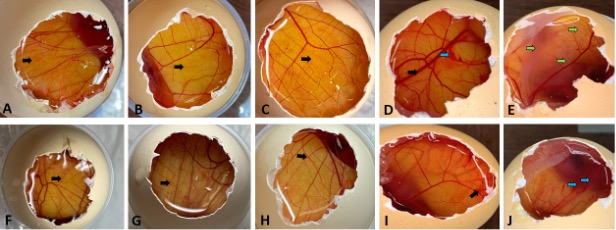
Ophthalmic disorders of infectious or inflammatory origin can often affect companion animals. In this context, research related to Caryocar brasiliense has shown benefits such as antibiotic, antioxidant, antifungal, and anti-inflammatory action, and it is expected to be beneficial for ophthalmopathy treatment. This research aimed to develop solutions of pequi peel and pulp extracts and then perform preclinical tests to assess the irritating potential using the HET-CAM test through the appearance of vascular lesions, simulating the ocular conjunctiva. For this purpose, 56 embryonated chicken eggs were subjected to solutions of ethanol extract of peel (EEP) and hexane extract of pulp (HEP) at concentrations of 0.1, 0.2, 0.,25, 1.0, and 2.5% for eyedrops of peel (EPe) and 1.0, 1.5, 2.,0, 10.0, and 20.0% for eyedrops of pulp (EPu), in addition to negative controls, consisting of Tween at 0.5 and 1.0% and NaCl. The positive control was performed with 0.1 N NaOH, and bleeding, hyperemia, and coagulation reactions were observed. The second-order polynomial was the regression model that best fitted the data, presenting the ideal value for EPu of 0.18% and EPe of 0.24%. The therapeutic benefits of C. brasiliense and the low potential for irritation of the tested solutions indicated a promising use for ophthalmopathies.
Downloads
References
Lorenzi, H. Árvores brasileiras: Manual de identificação e cultivo de plantas arbóreas nativas do Brasil. Nova Odessa: Plantarum. 1992 273p.
Lima A de, Silva AM de O e, Trindade RA, Torres RP, Mancini-Filho J. Composição química e compostos bioativos presentes na polpa e na amêndoa do pequi (Caryocar brasiliense, Camb.). Revista Brasileira de Fruticultura. 2007; 29(3):695–8. https://doi.org/10.1590/S0100-29452007000300052
Nascimento WM, Maia Filho ALM, Costa CLS da, Martins M, Araújo KS de. Estudo da resistência cicatricial cutânea de ratos tratados com óleo de pequi (Caryocar brasiliense). ConScientiae Saúde. 2016 Jan 21;14(3):449–55. https://doi.org/10.5585/conssaude.v14n3.5467
Batista JS, Silva AE, Rodrigues CMF, Costa KMFM, Oliveira AF, Paiva ES, et al. Avaliação Da Atividade Cicatrizante Do Óleo De Pequi (Caryocar coriaceum Wittm) Em Feridas Cutâneas Produzidas Experimentalmente Em Ratos. Arquivos do Instituto Biológico. 2010 Set;77(3):441–7. https://doi.org/10.1590/1808-1657v77p4412010
Ramos M.I.L., Umaki M.C.S., Hiane P.A., Ramos F. M. M. Efeito do cozimento convencional sobre os carotenóides pró-vitamínicos “A” da polpa do pequi (Caryocar brasiliense Camb). Boletim do Centro de Pesquisa de Processamento de Alimentos. 2023; 19(1). https://revistas.ufpr.br/alimentos/article/view/1219/1019
Selek H, Ünlü N, Orhan M, Irkeç M. Evaluation of Retinoic Acid Ophthalmic Emulsion in Dry Eye. European Journal of Ophthalmology. 2000 Abril; 10(2):121–7. https://doi.org/10.1177/112067210001000205
Ohashi Y, Watanabe H, Kinoshita S, Hosotani H, Umemoto M, Manabe R. Vitamin A Eyedrops for Superior Limbic Keratoconjunctivitis. American Journal of Ophthalmology. 1988 Mai;105(5):523–7.https://doi.org/10.1016/0002-9394(88)90245-0
Bruno-Filho FF, Ataíde WF, Stella AE, Benite-Ribeiro SA, Nebo L, Amaral AVC. Inhibition potential of Caryocar brasiliense on methicillin-resistant Staphylococcus pseudintermedius isolated from the ocular surface of dogs with ophthalmopathies. Arquivo Brasileiro de Medicina Veterinária e Zootecnia. 2023; 75(1):41–7. http://dx.doi.org/10.1590/1678-4162-12593
Figueira L, Torrão L, Dinis SA, Palmares J. Antibioterapia ocular. Segunda ed. Porto: Medesign. 2010, 151 p.
Gonzaléz JY. Uso tradicional de plantas medicinales em la Vereda San Isidro, Muncipio de San José de Pare Boyacá: um estudio preliminar usando tecnicas quantitativas. Acta Biológica Colombiana. 2006; 11(1):1-10. Available from: http://www.scielo.org.co/scielo.php?script=sci_arttext&pid=S0120-548X2006000200012&lng=en&nrm=iso
Abdelkader H, Pierscionek B, Carew M, Wu Z, Alany RG. Critical appraisal of alternative irritation models: three decades of testing ophthalmic pharmaceuticals. British Medical Bulletin. 2015 Fev 16;113(1):59–71. https://doi.org/10.1093/bmb/ldv002
Test No. 405: Acute Eye Irritation/Corrosion. OECD Guidelines for the Testing of Chemicals, Section 4. OECD; 2021. https://doi.org/10.1787/9789264185333-en
Oliveira, A. G. L. et al. Ensaios da membrana cório-alantoide (HET-CAM e CAM-TBS): alternativas para a avaliação toxicológica de produtos com baixo potencial de irritação ocular. Revista do Instituto Adolfo Lutz, São Paulo, v. 71, n. 1, p. 153-159, 2012. https://www.arca.fiocruz.br/handle/icict/8985
Eskes C, Bessou S, Bruner L, Curren R, Harbell J, Jones P, et al. Eye irritation. Alternative Laboratory Animal. 2005 jul; 33 (1): 47–81. https://doi.org/10.1177/026119290503301s09
Brasil. Resolução Nº 58, De 24 De Fevereiro De 2023. Dispõe sobre a proibição do uso de animais vertebrados, exceto seres humanos, em pesquisa científica, desenvolvimento e controle de produtos de higiene pessoal, cosméticos e perfumes que utilizem em suas formulações ingredientes ou compostos com segurança e eficácia já comprovadas cientificamente e dá outras providências. Diário Oficial da União: Sessão 1, Brasília, DF, ed. 41, p. 8, 01 de mar. 2023.
Luepke NP. Hen’s egg chorioallantoic membrane test for irritation potential. Food and Chemical Toxicology. 1985 feb; 23(2):287–91. https://doi.org/10.1016/0278-6915(85)90030-4
Luepke NP, Kemper FH. The HET-CAM test: An alternative to the draize eye test. Food and Chemical Toxicology. 1986 Jun; 24(6-7):495–6. https://doi.org/10.1016/0278-6915(86)90099-2
Leighton J, Nassauer J, Tchao R. The chick embryo in toxicology: an alternative to the rabbit eye. Food and Chemical Toxicology. 1985 Fev; 23(2):293–8. https://doi.org/10.1016/0278-6915(85)90031-6
Sebbag L, Park SA, Kass PH, Maggs DJ, Attar M, Murphy CJ. Assessment of tear film osmolarity using the TearLabTM osmometer in normal dogs and dogs with keratoconjunctivitis sicca. Veterinary Ophthalmology. 2016 Oct 20;20(4):357–64. https://doi.org/10.1111/vop.12436
Petersen-Jones SM, Crispin SM, British. BSAVA manual of small animal ophthalmology. 2ª ed. Gloucester: British Small Animal Veterinary Association; 2002.
Cushnie TPT, Lamb AJ. Antimicrobial activity of flavonoids. International Journal of Antimicrobial Agents. 2005 Nov;26(5):343–56. https://doi.org/10.1016/j.ijantimicag.2005.09.002
Paula-Ju W de, Rocha FH, Donatti L, Fadel-Picheth CMT, Weffort-Santos AM. Leishmanicidal, antibacterial, and antioxidant activities of Caryocar brasiliense Cambess leaves hydroethanolic extract. Revista Brasileira de Farmacognosia. 2006 Dec;16:625–30. https://doi.org/10.1590/S0102-695X2006000500007
Simões CMO. Farmacognosia: da planta ao medicamento. Florianópolis: Editora Da UFSC; Porto Alegre Editora Da Ufrgs; 1999.
Damico FM, Gasparin F, Ioshimoto GL, Igami TZ, Cunha JR. ADS, Fialho SL, et al. Intravitreal injection of polysorbate 80: a functional and morphological study. Revista do Colégio Brasileiro de Cirurgiões. 2017 Dec;44 (6):603–11. https://doi.org/10.1590/0100-69912017006010
Montanchez Mercado EC, Sam Zavala SY, Solis Cespedes PA, Ramirez Julca M. Use of the flowers of Cantua buxifolia Juss in the preparation of eye drops for eye irritation. Universidad Ciencia y Tecnología. 2022 Jun 30; 26(114):203–13. https://doi.org/10.47460/uct.v26i114.605.
Perches CS, Brandão CVS, Ranzani JJT, Pellizon CH, Donatti C, Fonzar JF, et al. Uso do colírio de Citrus lemon em úlceras de córnea induzidas em coelhos. Arquivo Brasileiro de Medicina Veterinária e Zootecnia. 2012 Oct; 64(5):1161–8. https://doi.org/10.1590/S0102-09352012000500012.
Dias FGG, Jorge AT, de Freitas Pereira L, Furtado RA, Ambrósio SR, Bastos JK, et al. Use of Copaifera multijuga for acute corneal repair after chemical injury: A clinical, histopathological and toxicogenetic study. Biomedicine & Pharmacotherapy. 2017 Dec;96:1193–8. https://doi.org/10.1016/j.biopha.2017.11.099
Curto EM, Labelle A, Chandler HL. Aloe vera: an in vitro study of effects on corneal wound closure and collagenase activity. Veterinary Ophthalmology. 2014 Mar 25;17(6):403–10. https://doi.org/10.1111/vop.12163.
Lisbão CBS, Corrêa MA, Ortiz JPD, Martins BC, Laus JL. Effects of the Ottonia martiana Miq. (Piperaceae) extract on dog’s ocular surface. Arquivo Brasileiro de Medicina Veterinária e Zootecnia. 2012 Jun; 64(3):577–84. https://doi.org/10.1590/S0102-0935201200030.
Portier CJ, Hoel DG. Optimal design of the chronic animal bioassay. Journal of Toxicology and Environmental Health. 1983 Jul 1; 12(1):1–19. https://doi.org/10.1080/15287398309530403
Ritz, C, Baty, F, Streibig, JC., & Gerhard, D. Dose-response analysis using R. PLoS One, 10(12), e0146021. 2015. https://doi.org/10.1371/journal.pone.0146021
Seber, G. A. F., & Lee, A. J. Linear Regression Analysis (2nd ed.). Wiley. 2012. https://doi.org/10.1002/9780471722199
Additional Files
Published
How to Cite
Issue
Section
License
Copyright (c) 2025 Brazilian Animal Science/ Ciência Animal Brasileira

This work is licensed under a Creative Commons Attribution 4.0 International License.
Authors who publish with this journal agree to the following terms:
- Authors retain copyright and grant the journal right of first publication with the work simultaneously licensed under a Creative Commons Attribution License that allows others to share the work with an acknowledgement of the work's authorship and initial publication in this journal.
- Authors are able to enter into separate, additional contractual arrangements for the non-exclusive distribution of the journal's published version of the work (e.g., post it to an institutional repository or publish it in a book), with an acknowledgement of its initial publication in this journal.
- Authors are permitted and encouraged to post their work online (e.g. in institutional repositories or on their website) prior to and during the submission process, as it can lead to productive exchanges, as well as earlier and greater citation of published work (See The Effect of Open Access).




Data statement
-
The research data is available on demand, condition justified in the manuscript