
Epidemiological and anatomopathological findings of type 1 and 2 abomasum ulcers in cattle with different comorbidities
DOI:
https://doi.org/10.1590/1809-6891v24e-74772EAbstract
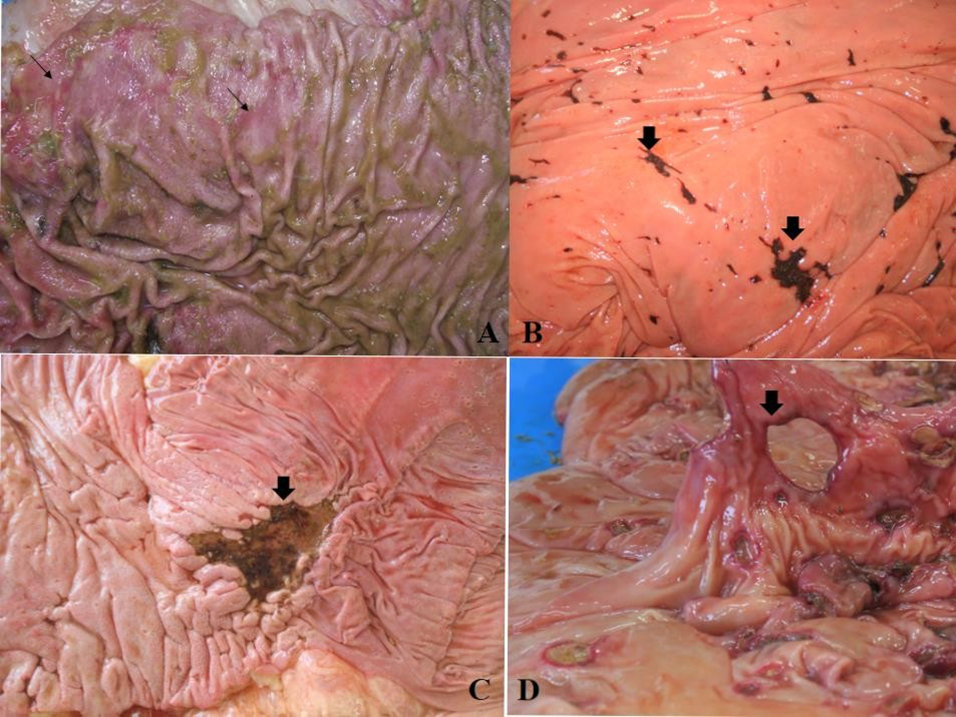
This study aimed to investigate the epidemiological and pathological findings of type 1 and 2 abomasal ulcers in cattle with different primary comorbidities. A total of 201 animals; 40/201 (20%) were young cattle under the age of two years and 161/201 (80%) were adult cattle over the age of two years, which were hospitalized for clinical care 152/201 (75,62%), 19/201 (9,45%) obstetric care, 17/201 (8,46%) surgical care and 13/201 (6,47%) for anatomopathological diagnosis, being euthanized or had natural death. The diagnosis of ulcers was based on the result of the post-mortem examination (macroscopic and histopathological analysis). Histopathological examination was performed on 201 fragments of ulcers and classified as type 1 or type 2. Of these, 193/201 (96.01%) corresponded to type 1 ulcers, of which 12/193 (5.97%) corresponded to subtype 1a lesions, 101/193 (50.25%) to subtype 1b, 77/ 193 (38.31%) to subtype 1c, 03/193 (1.49%) to subtype 1d, while 08/201 (3.98%) were type 2 ulcers. The ulcers were characterized by a focal, focally extensive, multifocal or diffuse inflammatory process, mainly by mononuclear cells. Abomasitis associated with ulcerated mucosa was found in 160/201 (79.60%). In 26/201 (12.93%) the abomasitis had diffuse foci of multifocal lymphocytic proliferation by atypical lymphocytes. Digestive and reproductive comorbidities were seen more frequently in cattle with type 1 or type 2 ulcers. The Subtype 1b focal ulcers and subtype 1a and 1b multifocal ulcers were more prevalent. In addition to the presence of comorbidities, most cases occur in the dry period, associated with feeding with higher amounts of concentrates and silages.
Key-words: dairy cattle; diseases of the abomasum; melena; ulcer; histopathology.
Downloads
References
Constable PD, Hinchcliff KW, Done SH, & Grünberg W. Veterinary Medicine: A textbook of the diseases of cattle, horses, sheep, pigs, and goats. 11a. ed. Elsevier. St. Louis, Missouri. 2017. p.2356.
Fubini SL, Yeager AE, & Divers TJ. Noninfectious Diseases of the Gastrointestinal Tract. In: Peek SF, &. Divers TJ. (Eds). Rebhun’s Diseases of Dairy Cattle: 3a. ed. Elsevier. St. Louis, Missouri; 2018. p. 168-245.
Francoz D, & Guard CL. Abomasal Ulcers. In: Bradford PS, David CVM, & Nicola P. Large Animal Internal Medicine. 6a ed. Elsevier, St. Louis, Missouri; 2020. p. 889–893.
Jelinski MD, Ribble CS, Chirino-Trejo M, Clark EG, & Janzen ED. The relationship between the presence of Helicobacter pylori, Clostridium perfringens type A, Campylobacter spp, or fungi and fatal abomasal ulcers in unweaned beef calves. Canadan. Vet. J. 1995;36:379-382.
Souza LM, Assis RN, Rego RO, Santos JF, Coutinho LT, Souza JCA, Mendonça CL, Afonso JAB, & Souto RJC. Achados clínicos, laboratoriais e anatomopatológicos de bezerros com úlceras de abomaso. Ciênc. Vet. Tróp. 2017;19(3):20-28.
Whitlock RH. Bovine stomach diseases. In: Anderson NV. (Ed). Veterinary Gastroenterology, Lea and Febiger, Philadelphia; 1980. p.425-428
Smith DF, Munson L, & Erb HN. Abomasal ulcer disease in adult dairy cattle. Cornell Vet. 1983;73(3):213–224.
Aukema JJ, & Breukink HJ. Abomasal ulcer in adult cattle with fatal haemorrhage. Cornell. Vet. 1974;64(2):303–317.
Palmer JE, & Whitlock RH. Bleeding abomasal ulcers in adult dairy cattle. J. Am. Vet. Med. Assoc. 1983;183(4):448–451.
Braun U, Gerspach C, Nuss K, Hässiga M, Hilbeb M, & Reif C. Clinical and laboratory findings, treatment and outcome in 145 cows with type-2 abomasal ulcer. Res. Vet. Sci. 2019;124:366–374.
Braun U, Gerspach C, Hilbe M, Devaux DJ, & Reif C. Clinical and laboratory findings in 60 cows with type-3 abomasal ulcer. Schweiz. Arch. Tierh. 2019;161(9):523–531.
Braun U, Reif C, Nuss K, Hilbe M., & Gerspach C. Clinical, laboratory and ultrasonographic findings in 87 cows with type- 4 abomasal ulcer. BMC. Vet. Res. 2019;15(1):100.
Braun U, Reif C, Hilbe M, & Gerspach C. Type-5 abomasal ulcer and omental bursitis in 14 cows. Act. Vet. Scand. 2020;62(1):4.
Braun U, Eicher R, & Ehrensperger F. Type 1 Abomasal Ulcers in Dairy Cattle. J. Vet. Med. 1991; 38(1–10):357–366.
Hund A, Beer T, & Wittek T. Abomasal ulcers in slaughtered cattle in Austria. Tierarztl. Prax. Ausg. G. Grosstiere. Nutztiere. 2016;44(5):279–285.
Ducharme NG, Desrochers A, Fubini SL, Pease AP, Mizer LA, Walker W, Trent AM, Roy JP, Rousseau M, Radcliffe RM, & Steiner A. Surgery of the bovine digestive system. In: Fubini SL, & Ducharme NG. (Eds). Farm Animal Surgery. 2a ed. Elsevier. St. Louis, Missouri; 2017. p.223-343.
Braun U, Gerspach C, Reif C, Hilbe M, & Nuss K. Clinical, laboratory and ultrasonographic findings in 94 cows with type- 1 abomasal ulcer. Schweizer. Arch. Tierh. 2020;162(4):235–244.
Ok M, Sem I, Turgut K, & Irmak K. Plasma gastrin activity and the diagnosis of bleeding abomasal ulcers in cattle. J. Vet. Med. 2001;48(9):563–568.
Mesarič M. Role of serum pepsinogen in detecting cows with abomasal ulcer. Vet. Arhiv. 2005;75(2):111–118.
Marshall TS. Abomasal Ulceration and Tympany of Calves. Vet. Clin. North Am. Food Anim. Pract. 2009; 25(1):209–220.
Hussain SA, Uppal SK, & Sood NK. Clinicopathological diagnosis of type-I abomasal ulceration in cattle and buffaloes. Indian. J. Vet. Pathol. 2015;39(3):239.
Silva Filho AP, Afonso JAB, Souza JCA, Dantas AC, Costa NA, & Mendonça CL. Achados clínicos de bovinos com úlcera de abomaso. Vet. Zootec. 2012;19(2):196–206.
Munch SL, Nielsen SS, Krogh MA, & Capion N. Prevalence of abomasal lesions in Danish Holstein cows at the time of slaughter. J. Dairy. Sci. 2019;102(6):5403–5409.
Nielsen SS, Krogh MA, Munch SL, & Capion N. Effect of non-perforating abomasal lesions on reproductive performance, milk yield and carcass weight at slaughter in Danish Holstein cows. Prev. Vet. Med. 2019;167(2):101–107.
Hund A, & Wittek T. Labmagengeschwüre beim Rind. Tierarztl. Prax. Ausg. G. Grosstiere. Nutztiere. 2017;45(02):121–128.
Luna SPL, & Teixeira MW. Eutanásia: considerações éticas e indicações técnicas. Revta. CFMV. 2007;13(41): 60-69.
Jensen R, Pierson RE, Braddy PM, Saari DA, Benitez A, Lauerman LH, Horton DP, & McChesney AE. Abomasal erosions in feedlot cattle. Am. J. Vet. Res. 1992;53(1):110-115.
Braun U, Bretscher R, & Gerber D. Bleeding abomasal ulcers in dairy cows. Vet. Rec. 1991;129(13):279-284.
Jelinski MD, Ribble CS, Campbell JR, Janzen ED. Investigating the relationship between abomasal hairballs and perforating abomasal ulcers in unweaned beef calves. Canadian Vet. J. 1996; 37(37):23-26.
Akbari H, Shahbazfar AA, Araghi-Sooreh A, Hassan-Nejad H, Zangisheh M, & Taheri M. Macroscopic and pathologic evaluation of cattle abomasal ulcers in Tabriz industrial slaughterhouse. Vet. Res. Biol. Prod. 2017;05(177):192-202.
Palmer J, Whitlock R. Perforated abomasal ulcers in adult dairy cows. J Am Vet Med Assoc 1984; 184: 171–174.
Hussain SA, Uppal SK, & Sood NK. The prevalence, frequency and topographic distribution of type 1-abomasal ulcers in water buffalo (bubalus bubalis): A case control study. Vet. Arhiv. 2019; 89(3): 317-330.
Tajik J, Khodakaram AT, Heidari M, & Babazadeh M. Prevalence, histopathological, and some epidemiological aspects of abomasal ulcers in water buffalo (Bubalus bubalis) in Iran. Comp. Clin. Path. 2013; 22(2):271-275.
Uzal FA, Plattner BL, & Hostetter JM. Alimentary System. In: Maxie MG. (Ed) Jubb, Kennedy, and Palmer’s Pathology of Domestic animals. Vol. 2. 6a. ed. Elsevier, St Louis, Missouri. 2016; p.1-257.
Murray MJ. Equine model of inducing ulceration in alimentary squamous epithelial mucosa. Dig. Dis. Sci. 1994; 39(12):2530-2535.
Jassim A, Yousif AAR, & Kshash QH. Study on Abomasal Ulcer in Sheep in Iraq. Int. J. Adv. Res. 2014;2(1):342-349.
Published
How to Cite
Issue
Section
License
Copyright (c) 2023 Brazilian Animal Science/ Ciência Animal Brasileira

This work is licensed under a Creative Commons Attribution 4.0 International License.
Authors who publish with this journal agree to the following terms:
- Authors retain copyright and grant the journal right of first publication with the work simultaneously licensed under a Creative Commons Attribution License that allows others to share the work with an acknowledgement of the work's authorship and initial publication in this journal.
- Authors are able to enter into separate, additional contractual arrangements for the non-exclusive distribution of the journal's published version of the work (e.g., post it to an institutional repository or publish it in a book), with an acknowledgement of its initial publication in this journal.
- Authors are permitted and encouraged to post their work online (e.g. in institutional repositories or on their website) prior to and during the submission process, as it can lead to productive exchanges, as well as earlier and greater citation of published work (See The Effect of Open Access).