
Estimativa da eficiência produtiva de ovelhas em pastagens naturais do Sul do Brasil: uma abordagem piloto
DOI:
https://doi.org/10.1590/1809-6891v26e-81645EResumo
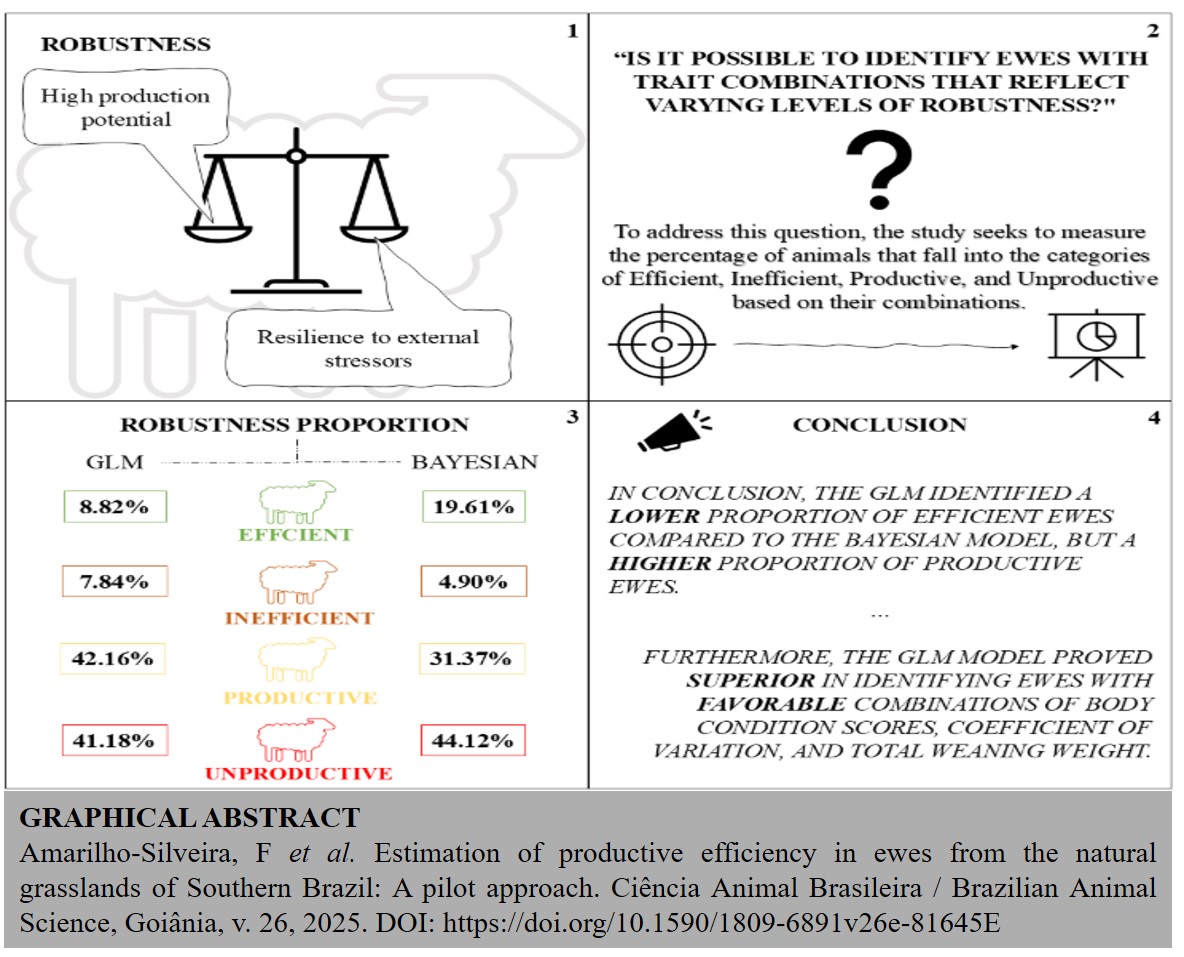
Este estudo piloto quantificou a proporção de ovelhas classificadas como Eficientes, Ineficientes, Produtivas e Não produtivas, usando dados coletados ao longo de um ciclo produtivo completo durante 2024, fornecidos por uma propriedade ovina. Para a classificação, foram empregados dois modelos: um modelo linear generalizado (GLM) utilizando quatro avaliações de escores de condição corporal (ECCs) como variáveis explicativas, e um modelo misto bayesiano (BMM) com quatro medições repetidas. Os resultados do GLM classificaram 8,82 % das ovelhas como Eficientes, 7,84 % como Ineficientes, 42,16 % como Produtivas e 41,18 % como Não produtivas. Por outro lado, o BMM categorizou 19,61% como Eficientes, 4,90 % como Ineficientes, 31,37 % como Produtivas e 44,12 % como Não produtivas. Este estudo fornece percepções iniciais sobre indicadores de eficiência produtiva em ovelhas, sugerindo que pesquisas adicionais por períodos mais longos, preferencialmente com os mesmos animais, são necessárias para obter resultados mais conclusivos. Ainda assim, esta abordagem apresenta um modelo de avaliação replicável, aplicável a diferentes escalas e ambientes. Em conclusão, o modelo GLM mostrou-se superior na identificação de ovelhas com combinações favoráveis de ECCs, coeficientes de variação e peso total dos cordeiros ao desmame.
Palavras-chave: classificação de ovelhas; escore de condição corporal; indicadores de eficiência produtiva; modelo linear generalizado; modelo misto bayesiano.
Downloads
Referências
De Barbieri I, Navajas E, Douhard F, Conington J, Ramos Z, Ciappesoni G. PL-8 A review of sheep resilience. Anim - Sci Proc. 2023 Mar;14(1):11–2. DOI: http://dx.doi.org/10.1016/j.anscip.2023.01.009
Knap PW. Breeding robust pigs. Austr J Exp Agric. 2005 Aug 29;45(8):763–73. DOI: http://dx.doi.org/10.1071/EA05041
Vialoux IM. Genetic parameters of body condition score (BCS) and effects of BCS and BCS change on ewe performance (Dissertation). [Palmerston North]: Massey University; 2020. Link: http://hdl.handle.net/10179/16391
Young MJ, Thomson BC. Robustness as a breeding objective for sheep in New Zealand. In: Hermesch S, editor. Breeding focus 2014 - Improving resilience. Armidale: Animal Genetics and Breeding Unit University of New England; 2014. p. 129–40. DOI: http://dx.doi.org/10.13140/2.1.5007.8403
Russel A. Body condition scoring of sheep. In: Boden E, editor. Sheep and goat practice. London: Baillière Tindall Ltd.; 1991. p. 3–10.
Bürkner P-C. brms: an R package for Bayesian multilevel models using stan. J Stat Softw. 2017;80(1):1–28. DOI: http://dx.doi.org/10.18637/jss.v080.i01
R Core Team. R: a language and environment for statistical computing. Vienna: R Foundation for Statistical Computing; 2021.
Wickham H. ggplot2: elegant graphics for data analysis [Internet]. Springer-Verlag New York. Springer-Verlag New; 2016 [cited 2024 Dec 11]. Available from: https://ggplot2.tidyverse.org
Schloerke B, Cook D, Larmarange J, Briatte F, Marbach M, Thoen E, et al. GGally: extension to “ggplot2.” R package version 2.2.1. Vienna: R Foundation for Statistical Computing; 2024.
Olsen LR. Cross-validation for model selection. Vienna: R Core Team; 2021. p. 1–100.
Macé T, González-García E, Pradel J, Parisot S, Carrière F, Douls S, et al. Genetic analysis of robustness in meat sheep through body weight and body condition score changes over time. J Anim Sci. 2018 Nov 21;96(11):4501–11. DOI: http://dx.doi.org/10.1093/jas/sky318
Friggens NC, Blanc F, Berry DP, Puillet L. Deciphering animal robustness. A synthesis to facilitate its use in livestock breeding and management. Animal. 2017 Dec;11(12):2237–51. DOI: http://dx.doi.org/10.1017/S175173111700088X
Tait IM, Kenyon PR, Garrick DJ, Lopez-Villalobos N, Pleasants AB, Hickson RE. Associations of body condition score and change in body condition score with lamb production in New Zealand Romney ewes. N Z J Anim Sci Prod. 2019;79:91–4.
Llonch P, Hoffmann G, Bodas R, Mirbach D, Verwer C, Haskell MJ. Opinion paper: measuring livestock robustness and resilience: are we on the right track?. Animal. 2020 Apr;14(4):667–9. DOI: http://dx.doi.org/10.1017/S17517311190033061. De Barbieri I, Navajas E, Douhard F, Conington J, Ramos Z, Ciappesoni G. PL-8 A review of sheep resilience. Anim - Sci Proc. 2023 Mar;14(1):11–2. DOI: http://dx.doi.org/10.1016/j.anscip.2023.01.009
Knap PW. Breeding robust pigs. Austr J Exp Agric. 2005 Aug 29;45(8):763–73. DOI: http://dx.doi.org/10.1071/EA05041
Vialoux IM. Genetic parameters of body condition score (BCS) and effects of BCS and BCS change on ewe performance (Dissertation). [Palmerston North]: Massey University; 2020. Link: http://hdl.handle.net/10179/16391
Young MJ, Thomson BC. Robustness as a breeding objective for sheep in New Zealand. In: Hermesch S, editor. Breeding focus 2014 - Improving resilience. Armidale: Animal Genetics and Breeding Unit University of New England; 2014. p. 129–40. DOI: http://dx.doi.org/10.13140/2.1.5007.8403
Russel A. Body condition scoring of sheep. In: Boden E, editor. Sheep and goat practice. London: Baillière Tindall Ltd.; 1991. p. 3–10.
Bürkner P-C. brms: an R package for Bayesian multilevel models using stan. J Stat Softw. 2017;80(1):1–28. DOI: http://dx.doi.org/10.18637/jss.v080.i01
R Core Team. R: a language and environment for statistical computing. Vienna: R Foundation for Statistical Computing; 2021.
Wickham H. ggplot2: elegant graphics for data analysis [Internet]. Springer-Verlag New York. Springer-Verlag New; 2016 [cited 2024 Dec 11]. Available from: https://ggplot2.tidyverse.org
Schloerke B, Cook D, Larmarange J, Briatte F, Marbach M, Thoen E, et al. GGally: extension to “ggplot2.” R package version 2.2.1. Vienna: R Foundation for Statistical Computing; 2024.
Olsen LR. Cross-validation for model selection. Vienna: R Core Team; 2021. p. 1–100.
Macé T, González-García E, Pradel J, Parisot S, Carrière F, Douls S, et al. Genetic analysis of robustness in meat sheep through body weight and body condition score changes over time. J Anim Sci. 2018 Nov 21;96(11):4501–11. DOI: http://dx.doi.org/10.1093/jas/sky318
Friggens NC, Blanc F, Berry DP, Puillet L. Deciphering animal robustness. A synthesis to facilitate its use in livestock breeding and management. Animal. 2017 Dec;11(12):2237–51. DOI: http://dx.doi.org/10.1017/S175173111700088X
Tait IM, Kenyon PR, Garrick DJ, Lopez-Villalobos N, Pleasants AB, Hickson RE. Associations of body condition score and change in body condition score with lamb production in New Zealand Romney ewes. N Z J Anim Sci Prod. 2019;79:91–4.
Llonch P, Hoffmann G, Bodas R, Mirbach D, Verwer C, Haskell MJ. Opinion paper: measuring livestock robustness and resilience: are we on the right track?. Animal. 2020 Apr;14(4):667–9. DOI: http://dx.doi.org/10.1017/S1751731119003306
Downloads
Arquivos adicionais
Publicado
Como Citar
Edição
Seção
Licença
Copyright (c) 2025 Ciência Animal Brasileira / Brazilian Animal Science

Este trabalho está licenciado sob uma licença Creative Commons Attribution 4.0 International License.
Autores que publicam nesta revista concordam com os seguintes termos:
- Autores mantém os direitos autorais e concedem à revista o direito de primeira publicação, com o trabalho simultaneamente licenciado sob a Licença Creative Commons Attribution que permite o compartilhamento do trabalho com reconhecimento da autoria e publicação inicial nesta revista.
- Autores têm autorização para assumir contratos adicionais separadamente, para distribuição não-exclusiva da versão do trabalho publicada nesta revista (ex.: publicar em repositório institucional ou como capítulo de livro), com reconhecimento de autoria e publicação inicial nesta revista.
- Autores têm permissão e são estimulados a publicar e distribuir seu trabalho online (ex.: em repositórios institucionais ou na sua página pessoal) a qualquer ponto antes ou durante o processo editorial, já que isso pode gerar alterações produtivas, bem como aumentar o impacto e a citação do trabalho publicado (Veja O Efeito do Acesso Livre).




Declaração de dados
-
Os dados de pesquisa estão disponíveis em um ou mais repositório de dados