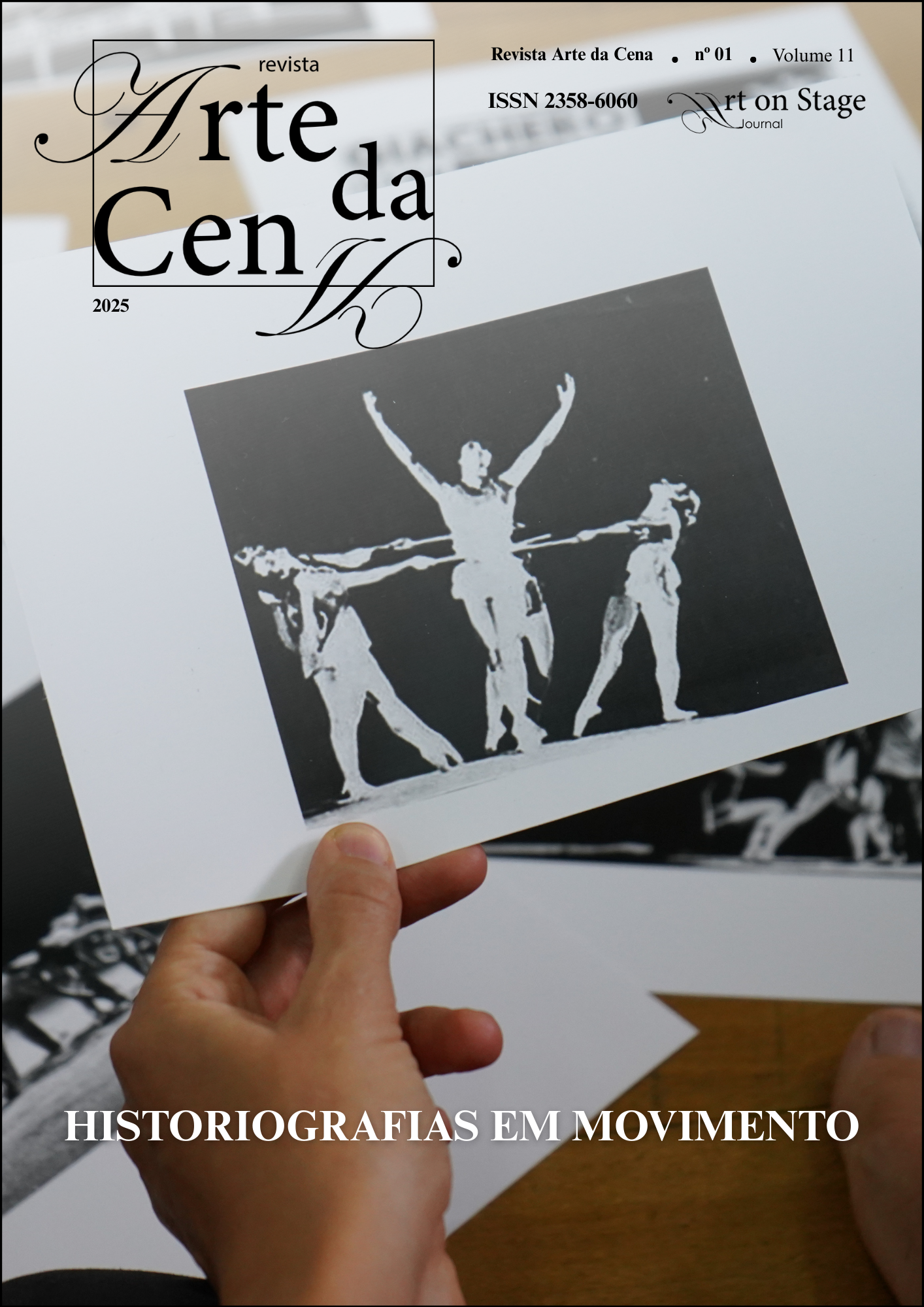
Illustrated Lecture on a Possible Re-imagination of the Ballet Tango (1955)
DOI:
https://doi.org/10.5216/ac.v11i1.82477Abstract
This performative lecture is a rehearsal on the impossibility of reconstructing or reenacting the ballet Tango, which was premiered in 1955 by the ballet company of the Teatro Argentino de La Plata (Buenos Aires, Argentina). It was composed by the musician and then director of the theater, Sebastián Lombardo, and choreographed by Roberto Giachero. This ballet was the first to place the language of dance and tango music on a lyrical stage in the spirit of classical music. In this way, the way in which Argentine nationalist ballets were conceived was transformed, although some central features remained: the search for a shared imaginary past, now urban, and the yearning for modernity.
Downloads
References
CADÚS, Eugenia. Danza y peronismo: disputas entre cultura de elite y culturas populares. Buenos Aires: Editorial Biblos, 2020. (Artes y medios).
CHONIATES, Nicetas; MAGOULIAS, Harry J. O city of Byzantium: annals of Niketas Choniatēs. Detroit: Wayne State University Press, 1984. (Byzantine texts in translation).
EL DÍA. «Tango» entraña una expresión atrayente. Circa 16 jul. 1955.
PAUSANIAS; JONES, William Henry Samuel; ORMEROD, Henry Arderne; et al. Description of Greece. Cambridge (Mass.) London: Harvard university press W. Heinemann, 1977. (Loeb classical library, 93, 188, 272, 297, 298).
TEATRO ARGENTINO. Programa de mano. 15 jul. 1955.
VARELA, Gustavo. Tango y política: sexo, moral burguesa y revolución en Argentina. 1a edición. Ciudad Autónoma de Buenos Aires: Ariel, 2016. (Historia).
Downloads
Published
Versions
- 2025-09-13 (2)
- 2025-09-02 (1)
How to Cite
Issue
Section
License
Copyright (c) 2025 Eugenia Cadús, Mateo de Urquiza

This work is licensed under a Creative Commons Attribution-NonCommercial 4.0 International License.
The Art on Stage Journal uses the Creative Commons - Attribution-Non-Commercial 4.0 International license as a basis for transferring rights, for open access journals (Open Archives Initiative - OAI).
Authors who publish in this journal agree with the following terms:
1) Authors retain the copyright and grant the Art on Stage Journal the right to first publication, with the work simultaneously licensed under the Creative Commons Attribution Non Commercial License.
2) Authors are authorized to assume additional contracts separately, for non-exclusive distribution of the version of the work published in this Journal (eg, publishing in institutional repository or as a book chapter), with acknowledgment of authorship and initial publication in this journal.
3) Authors are allowed and encouraged to publish and distribute their work online (eg in institutional repositories or on their personal page) at any point before or during the editorial process, provided that the reference to the place of publication is cited, that is, the electronic address / reference of Art on Stage Journal.
4) The authors of the works published in the Art on Stage are expressly responsible for their content.
5) Authors will not be paid for publication of works in the Art on Stage Journal.