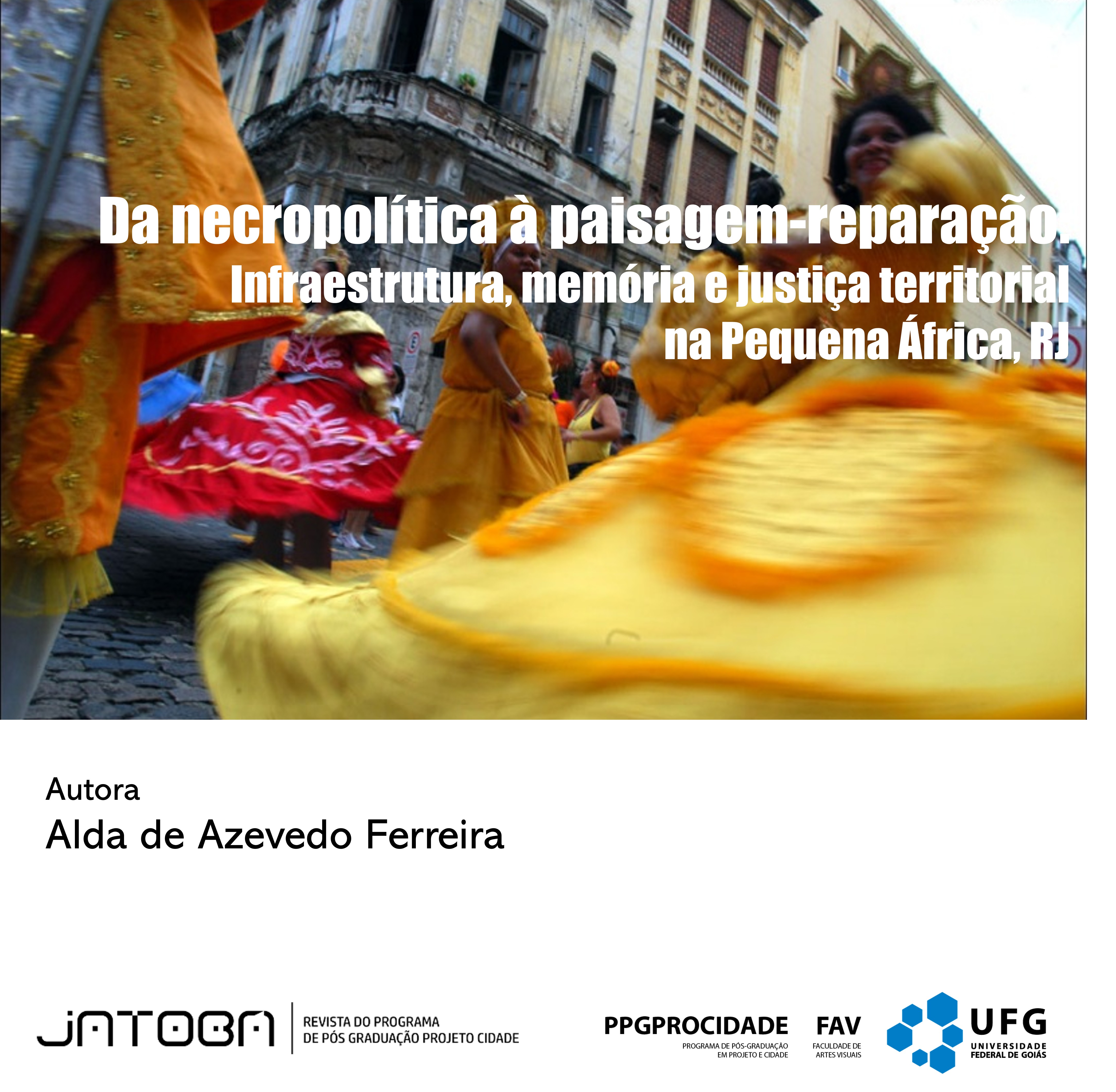
Necropolitics to landscape-reparation
infrastructure, memory, and territorial justice in the Little África, RJ
DOI:
https://doi.org/10.5216/revjat.v7.83195Keywords:
Cultural landscape, Urban justice, Covid-19, Landscape-Reparation, COVID-19, Rio de JaneiroAbstract
The Covid-19 pandemic deepened socio-spatial inequalities in Rio de Janeiro’s port area, disproportionately affecting Black communities in Little África — a historic territory tied to Afro-Atlantic memory. This article adopts a qualitative approach based on documentary analysis of heritage policies (2009–2024), minutes from the Valongo Wharf Management Committee, and official health and tourism indicators. Findings reveal that selective heritagization, combined with real estate speculation and infrastructural neglect, sustains urban necropolitics even in UNESCO-recognized sites. In response, the article proposes a Landscape-Reparation Agenda structured around four interconnected instruments: (I) the Atlantic Black Infrastructure Solidarity Fund (FANIS), funded by tourist revenue, tax exemptions, and progressive property taxation, supporting sanitation and housing permanence; (II) the Living Authenticity Index (IAV), which links fiscal benefits to the achievement of social and cultural benchmarks; (III) Inclusive Cultural Buffer Zones (ZACI), spatial overlays that connect heritage protection to the social function of housing; and (IV) the Termo Territorial Coletivo ((TTC, or Collective Land Tenure Agreement), a Brazilian legal mechanism inspired by Community Land Trusts that ensures collective land tenure and prevents speculative resale. The agenda seeks to reframe heritage conservation as a tool for territorial justice, weaving together memory, infrastructure, and community permanence across Black urban landscapes.
Downloads
References
ABREU, Maurício de Almeida. Evolução urbana do Rio de Janeiro. 4. ed. Rio de Janeiro: IPP, 2010.
ALCON, Alison; ALAIMO, Katherine. Food justice and community health. New York: Routledge, 2015.
ALNUSAIRAT, Sahar; ABU QADOURAH, Jameel; KHATTAB, Rola. “Assessing the future city post COVID-19: linking the SDGs, health, resilience, and psychological impact”. Sustainability, v. 15, e811, 2023.
ARAUJO, Ana Lucia. Reparations for slavery and the slave trade: a transnational and comparative history. London: Bloomsbury Academic, 2017.
BANCO INTERAMERICANO DE DESENVOLVIMENTO. Water, sanitation, and hygiene (WASH) impact evaluation toolkit. Washington, DC, 2019.
BARDIN, Laurence. Análise de conteúdo. São Paulo: Edições 70, 2011.
BASILE, Priscila. “Vulnerability, neglect, and collectivity in Brazilian favelas: surviving the threats of the COVID-19 pandemic and the State’s necropolitics”. Urban Studies, v. 60, n. 9, p. 1690-1706, 2023.
BASTOS LIMA, Mateus; HATZIKIDI, Katerina; COSTA, Karla. “Gore capitalism and necropolitics in Brazil’s malgovernance of the COVID-19 pandemic”. Latin American Perspectives, v. 52, n. 1, p. 89-101, 2025. DOI: 10.1177/0094582X241311804.
BENTO, Cida. O pacto narcísico da branquitude: racismo, antirracismo e branquitude no Brasil. 2. ed. São Paulo: Companhia das Letras, 2022.
BID – BANCO INTERAMERICANO DE DESENVOLVIMENTO. Metodologia WASH para avaliação de impacto em projetos de saneamento em assentamentos precários. Washington, DC, 2019.
BOUCUM, Cheikh. La Maison des Esclaves de Gorée: enjeux patrimoniaux et développement local. Dakar: IFAN, 2006.
BRASIL. Decreto n.º 9.759, de 11 abril 2019. Dispõe sobre os colegiados da administração pública federal direta, autárquica e fundacional. Diário Oficial da União, Brasília, DF, 12 abr. 2019.
BRASIL. Lei n.º 10 257, de 10 de julho de 2001. Estatuto da Cidade.
BRASIL. Termo de Ajustamento de Conduta n.º 01/2024 – Cais do Valongo. Rio de Janeiro: IPHAN/Prefeitura/CDURP, 2024.
CARDOSO, Bruno. “CEPACs e o Porto Maravilha: financeirização do direito de construir”. Cadernos Metrópole, v. 24, n. 54, p. 49-71, 2022.
COMITÊ GESTOR DO SÍTIO ARQUEOLÓGICO CAIS DO VALONGO (CGCAV). Ata da 1.ª reunião ordinária, 23 de março de 2023. Rio de Janeiro: CGCAV, 2023a.
COMITÊ GESTOR DO SÍTIO ARQUEOLÓGICO CAIS DO VALONGO (CGCAV). Ata da 4.ª reunião ordinária, 17 de abril de 2023. Rio de Janeiro: CGCAV, 2023b.
COMITÊ GESTOR DO SÍTIO ARQUEOLÓGICO CAIS DO VALONGO (CGCAV). Ata da 7.ª reunião ordinária, 21 de agosto de 2023. Rio de Janeiro: CGCAV, 2023c.
COMITÊ GESTOR DO SÍTIO ARQUEOLÓGICO CAIS DO VALONGO (CGCAV). Ata da 8.ª reunião ordinária, 11 de setembro de 2023. Rio de Janeiro: CGCAV, 2023d.
COMPANHIA CARIOCA DE PARCERIAS ESTRATÉGICAS. Ofício nº 18/2023 – Diretrizes para o programa Reviver Centro. Rio de Janeiro, 2023. Disponível em: https://paisdorio.rio/ccpar. Acesso em: 16 jun. 2025.
COSGROVE, Denis. Social formation and symbolic landscape. Madison: University of Wisconsin Press, 1984.
DEFENSORIA PÚBLICA DO ESTADO DO RIO DE JANEIRO (DPRJ). Relatório de ações contra despejos na pandemia. Rio de Janeiro, 2021.
DUARTE, Cristiane Rose; PINHEIRO, Ethel (Orgs.). Arquitetura, subjetividade e cultura: cenários de pesquisa no Brasil e pelo mundo. Rio de Janeiro: LASC/PROARQ-UFRJ, 2020.
DUNCAN, James; DUNCAN, Nancy. Landscapes of privilege: the politics of the aesthetic in an American suburb. New York: Routledge, 2003.
EDENSOR, Tim. Industrial ruins: space, aesthetics, and materiality. Oxford: Berg, 2005.
ESCOBAR, Arturo. Designs for the pluriverse: radical interdependence, autonomy, and the making of worlds. Durham: Duke University Press, 2018.
FARIA, Maria Lúcia B.; KEUCHKARIAN, Dulce A. "Os desafios da conservação urbana em áreas centrais submetidas a projetos de renovação: região portuária da cidade do Rio de Janeiro". Cuadernos de Educación y Desarrollo, v. 15, n. 11, p. 14379-14397, 2023.
FERREIRA, Alda de Azevedo. Política da paisagem: desafios e práticas em etnoconservação urbana. Rio de Janeiro: Uiclap, 2024.
FERRETTI, Federico. “Justice and cultural landscape: notes for a critical geography of heritage”. ACME, v. 18, n. 6, p. 1341-1360, 2019.
FIPEZAP. Índice residencial Brasil – Relatório anual 2025. São Paulo: Fipe, 2025.
FLORIDA, Richard. “What’s the future of cities in the aftermath of COVID-19?”. Development Magazine, Summer 2023.
GILROY, Paul. The Black Atlantic: modernity and double consciousness. London: Verso, 1993.
GONZALEZ, Lélia. A categoria político-cultural de amefricanidade. Tempo Brasileiro, Rio de Janeiro, n. 92/93, p. 69-82, 1988.
HALBWACHS, Maurice. A memória coletiva. São Paulo: Vértice, 1992.
HARVEY, David. O novo imperialismo. São Paulo: Loyola, 2003.
_____. Rebel cities: from the right to the city to the urban revolution. London: Verso, 2012.
HOYLE, Brian. “Global and local change on the port-city waterfront.” Geographical Review, v. 90, n. 3, p. 395-417, 2000.
HOLSTON, James. A cidade e a “colonização de classes”: segregação e insurgência nas periferias urbanas. Cadernos Metrópole, São Paulo, v. 21, n. 46, p. 25-45, 2019.
HOOKS, bell. “Representing whiteness in the Black imagination.” In: RUTHERFORD, Jonathan (org.). Identity: community, culture, difference. London: Lawrence & Wishart, 1992. p. 338-346.
INSTITUTO DO PATRIMÔNIO HISTÓRICO E ARTÍSTICO NACIONAL (IPHAN). Dossiê de candidatura do Cais do Valongo à Lista do Patrimônio Mundial. Brasília, 2016.
INSTITUTO DO PATRIMÔNIO HISTÓRICO E ARTÍSTICO NACIONAL (IPHAN). Plano de execução do Novo PAC – Patrimônio Cultural. Brasília, 2024.
JACOBS, Jane. The death and life of great American cities. New York: Random House, 1961.
JLL. Relatório de mercado – Rio de Janeiro (3º trim. 2023). São Paulo: Jones Lang LaSalle, 2023.
KRIPPENDORFF, Klaus. Content analysis: an introduction to its methodology. 4. ed. Thousand Oaks: Sage, 2018.
LEES, Loretta; SHIN, Hyun Bang; LÓPEZ-MORALES, Ernesto (org.). Planetary gentrification. Cambridge: Polity, 2016.
LEFEBVRE, Henri. The production of space. Oxford: Blackwell, 1991.
LIMA, Tânia A.; SENE, Glaucia M.; SOUZA, Marcos A. Em busca do Cais do Valongo. Anais do Museu Paulista, v. 24, n. 1, p. 299-391, 2016.
LOGAN, William. “Sealed sites: contested memories of slavery in the urban landscape.” International Journal of Heritage Studies, v. 18, n. 6, p. 591-604, 2012.
LOPES, Nei. Enciclopédia brasileira da diáspora africana. 2. ed. São Paulo: Selo Negro, 2011.
MACDONALD, Sharon. Difficult heritage: negotiating the Nazi past in Nuremberg and beyond. Londres: Routledge, 2009.
MACDONALD, Sharon. Memorylands: heritage and identity in Europe today. Londres: Routledge, 2015.
MATTOS, Hebe; ABREU, Martha; GURAN, Milton (org.). Inventário dos lugares de memória do tráfico atlântico de escravos e da história dos africanos escravizados no Brasil. Niterói: LABHOI/UFF, 2014.
MBEMBE, Achille. Necropolítica. São Paulo: n-1 Edições, 2016.
McKITTRICK, Katherine. “On plantations, prisons, and a Black sense of place.” Social & Cultural Geography, v. 12, n. 8, p. 947-963, 2011.
MILES, Matthew; HUBERMAN, A. Michael; SALDAÑA, Johnny. Qualitative data analysis: a methods sourcebook. 4. ed. Thousand Oaks: Sage, 2014.
MINISTÉRIO DAS CIDADES. Portaria n.º 1, de 23 de janeiro de 2024. Estabelece diretrizes para Termo Territorial Coletivo no âmbito da REURB.
MITCHELL, Don. “Landscape justice.” In: OHLSSON, J.; PRZYBYLINSKI, S. (org.). Theorizing justice: a primer for social scientists. Bristol: Bristol University Press, 2023. p. 205-222.
MOLOTCH, Harvey. “The city as a growth machine: toward a political economy of place.” American Journal of Sociology, v. 82, n. 2, p. 309-332, 1977.
NASCIMENTO, Abdias. O quilombismo: documentos de uma militância pan-africanista. Rio de Janeiro: Paz e Terra, 1980.
NIXON, Rob. Slow violence and the environmentalism of the poor. Cambridge: Harvard University Press, 2011.
ORGANIZAÇÃO DAS NAÇÕES UNIDAS PARA A EDUCAÇÃO, A CIÊNCIA E A CULTURA (UNESCO). Policy for the integration of a sustainable development perspective into the processes of the World Heritage Convention. Paris, 2015. Disponível em: https://whc.unesco.org/document/139346. Acesso em: 16 jun. 2025.
REIS, Lazuli. “Porto Maravilha recebe primeiros moradores de novos residenciais: ‘é uma grande emoção’, diz proprietária”. O Globo, Rio de Janeiro, 28 ago. 2024. Disponível em: https://oglobo.globo.com/. Acesso em: 16 jun. 2025.
RICŒUR, Paul. A memória, a história, o esquecimento. Campinas: Unicamp, 2004.
RIO DE JANEIRO (Estado). Secretaria de Estado de Turismo – SETUR/RJ. Boletim estatístico de turismo: ano-base 2023. Rio de Janeiro: SETUR/RJ, 2023. Disponível em: https://turismo.rj.gov.br/. Acesso em: 16 jun. 2025.
RIO DE JANEIRO (Município). Decreto n.º 47 306, de 11 de maio de 2020. Regulamenta o IPTU progressivo.
RODRÍGUEZ CÁCERES, Rafael; VASSALLO, Régis. Valongo: patrimônio mundial e memória negra. Rio de Janeiro: Garamond, 2021.
RODWELL, Dennis. “Authenticity and the ethics of heritage conservation.” Journal of Cultural Heritage Management, v. 10, n. 4, p. 278-295, 2020.
ROY, Arundhati. “The pandemic is a portal.” Financial Times, London, 3 apr. 2020. Disponível em: https://www.ft.com/. Acesso em: 16 jun. 2025.
SARACENI, Vitor; CRUZ, Oswaldo G.; CAVALCANTE, J. Ricardo; et al. “Excess mortality from all causes during the COVID-19 pandemic in the city of Rio de Janeiro, Brazil”. Revista Brasileira de Epidemiologia, v. 26, e230013, 2023.
SMITH, Neil. The new urban frontier: gentrification and the revanchist city. London: Routledge, 1996.
SMITH, Laurajane. Uses of heritage. London: Routledge, 2006.
SUIAMA, Sergio. “Cais do Valongo: a luta antirracista pela memória da escravidão afro-atlântica”. Revista de Direito e Memória, v. 2, n. 1, p. 75-98, 2023.
SUPREMO TRIBUNAL FEDERAL (Brasil). Ação Direta de Inconstitucionalidade 6121. Rel. Min. Rosa Weber. Brasília, 13 jun. 2019.
TUNBRIDGE, James; ASHWORTH, Gregory. Dissonant heritage: the management of the past as a resource in conflict. Chichester: Wiley, 1996.
UNESCO. Decision 41 COM 8B.2 – Cais do Valongo. Paris, 2017.
UN-HABITAT. World cities report 2024: financing sustainable urban futures. Nairobi: United Nations Human Settlements Programme, 2024. Disponível em: https://unhabitat.org/. Acesso em: 16/06/2025.
WATERTON, Emma. “Taking stock.” Landscape Research, v. 47, n. 1, p. 1-4, 2022.
ZHAO, Meng; LIU, Ning; CHEN, Jian; et al. “Navigating post-COVID-19 social-spatial inequity: unravelling the nexus between community conditions, social perception and spatial differentiation”. Land, v. 13, e563, 2024.
ZHOU, Kai; CHEN, Bin. “Envisioning landscape justice: interdisciplinary dialogue, collaboration, and exploration.” Landscape Architecture Frontiers, v. 12, n. 4, p. 4-7, 2024.
ZUKIN, Sharon. Naked city: the death and life of authentic urban places. Oxford: Oxford University Press, 2010.
Downloads
Published
How to Cite
Issue
Section
License
- Autores mantém os direitos autorais e concedem à revista o direito de primeira publicação, com o trabalho simultaneamente licenciado sob a Licença Creative Commons Attribution 4.0 que permite o compartilhamento do trabalho com reconhecimento da autoria e publicação inicial nesta revista.
- Autores têm autorização para assumir contratos adicionais separadamente, para distribuição não-exclusiva da versão do trabalho publicada nesta revista (ex.: publicar em repositório institucional ou como capítulo de livro), com reconhecimento de autoria e publicação inicial nesta revista.
- Autores têm permissão para publicar e distribuir seu trabalho online (ex.: em repositórios institucionais ou na sua página pessoal) após a publicação inicial nesta revista, já que isso pode gerar alterações produtivas, bem como aumentar o impacto e a citação do trabalho publicado (Veja O Efeito do Acesso Livre).
- Foram feitos todos os esforços para identificar e creditar os detentores de direitos sobre as imagens publicadas. Se tem direitos sobre alguma destas imagens e não foi corretamente identificado, por favor, entre em contato com a revista Jatobá e publicaremos a correção num dos próximos números.