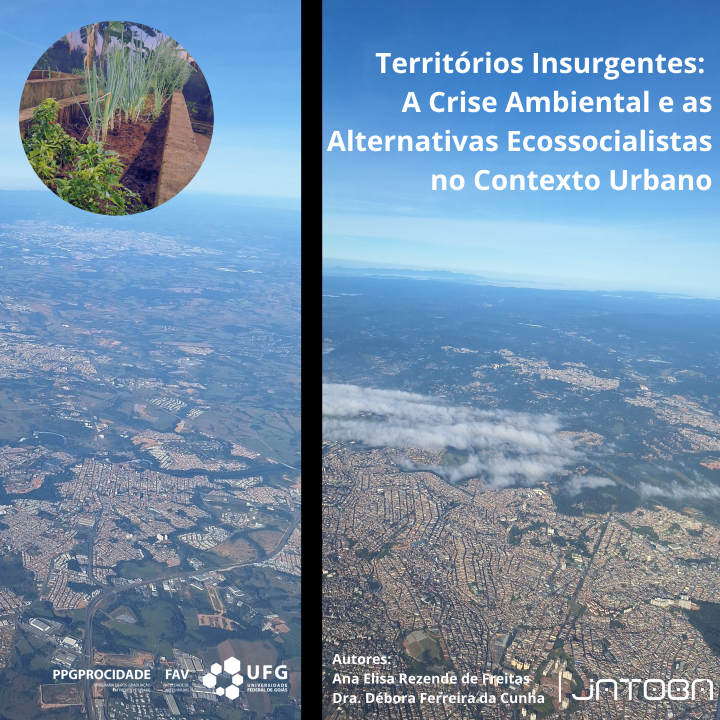
Insurgent Territories
The Environmental Crisis and Ecosocialist Alternatives in the Urban Context
DOI:
https://doi.org/10.5216/revjat.v7.83004Keywords:
Ecosocialism, Environmental crisis, Environmental justice, Sustainable urban planning, Brazilian citiesAbstract
This article analyzes the impacts of environmental crises on major Brazilian cities, discussing the potential of ecosocialist alternatives to mitigate their effects through sustainable urban solutions. The research adopts a qualitative approach and a deductive method, based on a literature review and documentary analysis of municipal inventories and public policies. It is assumed that climate change exacerbates urban inequalities, disproportionately affecting peripheral territories and vulnerable populations (Acselrad, 2009; Maricato, 2011). In this context, ecosocialism offers a critical theoretical framework that advocates for a reorganization of the relationship between society and nature, breaking with the productivist logic of urban capitalism (Angus, 2016; Löwy, 2019). Practices such as urban gardening, solidarity economy networks, and green infrastructure emerge as concrete expressions of socio-environmental resistance and territorial self-management (Justo, 2020; Quinto et al., 2021). It was found that public policies grounded in environmental justice, popular participation, and the territorialization of rights are essential to addressing climate crises at the local level. The study concludes that an ecosocialist transition requires expanding democratic governance mechanisms, adopting inclusive planning tools, and recognizing the role of peripheral communities in building resilient cities (Harvey, 2012; Swyngedouw; Kaika, 2014). When linked to international networks such as C40 and ICLEI, these measures may foster new urban institutionalities committed to sustainability and equity.
Downloads
References
ACSELRAD, Henri. Justiça Ambiental e Cidadania. 2. ed. Rio de Janeiro: Lamparina, 2009.
ANGUELOVSKI, Isabelle; CONNOLLY, James J. T.; COLE, Helen; et al. Green gentrification in European and North American cities. Nature Communications, London, v. 13, art. 3816, 2022. Disponível em: https://doi.org/10.1038/s41467-022-31572-1. Acesso em: 7 jun. 2025.
ANGUS, Ian. Facing the Anthropocene: Fossil Capitalism and the Crisis of the Earth System. New York: Monthly Review Press, 2016.
BARDIN, Laurence. Análise de conteúdo. 6. ed. São Paulo: Edições 70, 2011.
BEATLEY, Timothy. Green Urbanism: Learning from European Cities. [E-book]. Washington, D.C.: Island Press, 2012. ISBN 9781610910132. Disponível em: https://islandpress.org/books/green-urbanism. Acesso em: 02 out. 2024.
BELO HORIZONTE. Inventário de Emissões de Gases de Efeito Estufa de Belo Horizonte. Prefeitura de Belo Horizonte, 2021. Disponível em: https://prefeitura.pbh.gov.br/sites/default/f iles/estrutura-de-governo/meio-ambiente/inventariofinal.pdf. Acesso em: 30 set. 2024.
BULKELEY, Harriet; CASTÁN BROTO, Vanessa; EDWARDS, Gareth A. S. Cities and Climate Change: Urban Sustainability and Global Environmental Governance. Londres: Routledge, 2013.
C40 CITIES. Cities100: Rio de Janeiro – Reservoirs and River Diversion Prevent Flooding. C40 Cities, 2015. Disponível em: https://www.c40.org/case-studies/cities100-rio-de-janeiro-reservoirs-and-river-diversion-prevent-flooding/. Acesso em: 02 de out. de 2024.
DINIZ, Fabiano Rocha; VIEIRA FILHO, Luiz; MONTEZUMA, Roberto. The Capibaribe Park Project, Recife: Using the River to Reinvent the City. Revista Brasileira de Ciências Ambientais (RBCIAMB), n. 55, p. 331-353, 2020. Disponível em: https://doi.org/10.5327/Z2 176-947820200619. Acesso em: 02 out. 2024.
ESCOBAR, Herton. Dados comprovam aumento de eventos climáticos extremos em São Paulo. Jornal da USP, São Paulo, 21 fev. 2020. Disponível em: https://jornal.us p.br/ciencias/ciencias-ambientais/dados-comprovam-aumento-de-eventos-climaticos-extremos-em-sao-paulo/. Acesso em: 7 jun. 2025.
FLICK, Uwe. Introdução à pesquisa qualitativa. 5. ed. Porto Alegre: Penso, 2018.
GUTIÉRREZ AGUILAR, Raquel. Rhythms of the Pachakuti: indigenous uprising and state power in Bolivia. Durham: Duke University Press, 2014. Disponível em: https://www.dukeupress.edu/rhythms-of-the-pachakuti. Acesso em: 7 jun. 2025.
HARVEY, David. Justice, Nature, and the Geography of Difference. Malden: Blackwell, 1996.
HARVEY, David. Spaces of Global Capitalism: A Theory of Uneven Geographical Development. Londres: Verso, 2006.
HARVEY, David. Rebel Cities: From the Right to the City to the Urban Revolution. London: Verso, 2012.
HENRIQUE, Karen Paiva. Landscapes of dispossession: examining adaptation and the persistent exclusion of the urban poor. International Journal of Urban and Regional Research, v. 42, n. 5, p. 864-881, 2018. Disponível em: https://www.sydney.edu.au/sydney-environment-institute/news/2018/01/11/ej-series--part-9--landscapes-of-dispossession---examining-adapt.html. Acesso em: 02 de out. de 2024.
IPCC – INTERGOVERNMENTAL PANEL ON CLIMATE CHANGE. Climate change 2022: impacts, adaptation and vulnerability. Contribution of Working Group II to the Sixth Assessment Report of the Intergovernmental Panel on Climate Change. Cambridge: Cambridge University Press, 2022. Disponível em: https://www.ipcc.ch/report/ar6/wg2/. Acesso em: 7 jun. 2025.
JUSTO, Marcelo Gomes. Agroecologia e agricultura urbana na cidade de São Paulo: movimentos socioespaciais e socioterritoriais. Revista NERA, v. 23, n. 55, p. 218-242, 2020. Disponível em: https://doi.org/10.47946/rnera.v0i55.6671. Acesso em: 02 out. 2024.
KABISCH, Nadja et al. Nature-based solutions to climate change mitigation and adaptation in urban areas: perspectives on indicators, knowledge gaps, barriers, and opportunities for action. Ecology and Society, v. 21, n. 2, art. 39, 2016. Disponível em: https://www.ecologyandsociety.org/vol21/iss2/art39/. Acesso em: 7 jun. 2025.
LEFEBVRE, Henri. O direito à cidade. Tradução de Rubens Eduardo Frias. São Paulo: Centauro, 2001.
MARENGO, José A. Mudanças climáticas, impactos e políticas públicas para reduzir impactos. ClimaCom, 2019. Disponível em: https://climacom.mudancasclimaticas.net.br/muda ncas-climaticas-impactos-e-politicas-publicas-para-reduzir-impactos/. Acesso em: 02 de out. de 2024.
MARICATO, Ermínia. O impasse da política urbana no Brasil. Petrópolis: Vozes, 2011.
MINAYO, Maria Cecília de Souza. O desafio do conhecimento: pesquisa qualitativa em saúde. 15. ed. São Paulo: Hucitec, 2021.
QUINTO, António Carlos; FERREIRA, Ivanir; IRALA, Bruna. Hortas comunitárias resistem à urbanização na maior metrópole do Brasil. Jornal da USP, São Paulo, 5 nov. 2021. Disponível em: https://jornal.usp.br/ciencias/hortas-comunitarias-resistem-a-urbanizacao-na-maior-metropole-do-brasil/. Acesso em: 7 jun. 2025.
RECIFE. Inventário de Emissões de Gases de Efeito Estufa de Recife. Prefeitura de Recife, 2017. Disponível em: http://meioambiente.recife.pe.gov.br/sites/default/files/midia/arquivos /pagina-basica/3o_inventario_de_emissoes_de_gases_de_efeito_estufa_do_recife.pdf. Acesso em: 30 set. 2024.
RIO DE JANEIRO. Inventário de Emissões de Gases de Efeito Estufa de Rio de Janeiro. Prefeitura do Rio de Janeiro, 2012. Disponível em: https://www.rio.rj.gov.br/dlstatic/10112/9 857523/4243419/InventariodeEmissoesdeGasesdeEfeitoEstufa2015.pdf. Acesso em: 30 set. 2024.
SACHS, Jeffrey. The Age of Sustainable Development. Nova York: Columbia University Press, 2015.
SÃO PAULO. Inventário de Emissões de Gases de Efeito Estufa de São Paulo. Prefeitura de São Paulo, 2021. Disponível em: https://www.prefeitura.sp.gov.br/cidade/secretarias/upload /meio_ambiente/NOVO_Planilha%20sIntese%20InventArio%202021(2).pdf. Acesso em: 30 set. 2024.
SCHLOSBERG, David. Defining environmental justice: theories, movements, and nature. Oxford: Oxford University Press, 2007. Disponível em: https://books.goo gle.com/books/about/Defining_Environmental_Justice.html?id=LGNFPgAACAAJ. Acesso em: 7 jun. 2025.
KAIKA, Maria; SWYNGEDOUW, Erik. The urbanization of nature: great promises, impasse, and new beginnings. In: BRIDGE, Gary; WATSON, Sophie (org.). The new Blackwell companion to the city. Oxford: Wiley-Blackwell, 2011. p. 96–107. Disponível em: https://www.academia.edu/12147925/Kaika_M_and_Swyng edouw_E _2011_The_Urbanization_of_Nature_Great_Promises_Impasse_and_New_Beginnings_In_Bridge_G_and_Watson_S_eds_The_New_Blackwell_Companion_to_the_City_pp_96_107_Oxford_Blackwell. Acesso em: 7 jun. 2025.
SWYNGEDOUW, Erik; KAIKA, Maria. Urban political ecology: great promises, deadlock… and new beginnings? Documents d’Anàlisi Geogràfica, Bellaterra, v. 60, n. 3, p. 459–481, 2014. Disponível em: https://www.raco.cat/index.php/Documents Analisi/article/view/291302. Acesso em: 7 jun. 2025.
UNA CITY. Recreio Green Corridor - Rio de Janeiro. Urban Nature Atlas, 2023. Disponível em: https://una.city/nbs/rio-de-janeiro/recreio-green-corridor. Acesso em: 02 de out. de 2024.
VILLAVICENCIO-VALDEZ, Gabriela Valeria; JACOBI, J.; SCHNEIDER, M.; ALTIERI, M. A.; SUZÁN-AZPIRI, H. Urban agroecology enhances agrobiodiversity and resilient, biocultural food systems: The case of the semi-dryland and medium-sized Querétaro City, Mexico. Frontiers in Sustainable Food Systems, 2020. Disponível em: https://www.frontiersin.org/articles/10.3389/fsufs.2020.587607/full. Acesso em: 02 de out. de 2024.
ZENG, Chen; DENG, Xiangzheng; DONG, Jianing; HU, Peiying. Urbanization and Sustainability: Comparison of the Processes in “BIC” Countries. Sustainability, v. 8, n. 4, p. 400, 2016. Disponível em: https://www.mdpi.com/2071-1050/8/4/400. Acesso em: 02 de out. de 2024.
Downloads
Published
How to Cite
Issue
Section
License
- Autores mantém os direitos autorais e concedem à revista o direito de primeira publicação, com o trabalho simultaneamente licenciado sob a Licença Creative Commons Attribution 4.0 que permite o compartilhamento do trabalho com reconhecimento da autoria e publicação inicial nesta revista.
- Autores têm autorização para assumir contratos adicionais separadamente, para distribuição não-exclusiva da versão do trabalho publicada nesta revista (ex.: publicar em repositório institucional ou como capítulo de livro), com reconhecimento de autoria e publicação inicial nesta revista.
- Autores têm permissão para publicar e distribuir seu trabalho online (ex.: em repositórios institucionais ou na sua página pessoal) após a publicação inicial nesta revista, já que isso pode gerar alterações produtivas, bem como aumentar o impacto e a citação do trabalho publicado (Veja O Efeito do Acesso Livre).
- Foram feitos todos os esforços para identificar e creditar os detentores de direitos sobre as imagens publicadas. Se tem direitos sobre alguma destas imagens e não foi corretamente identificado, por favor, entre em contato com a revista Jatobá e publicaremos a correção num dos próximos números.