ÉTICA E ONTOLOGIA EM KANT E TUGENDHAT
DOI:
https://doi.org/10.5216/phi.v6i1/2.3128Abstract
A noção de ética defendida pela tradição analítica está baseada no pressuposto de que toda ética deve ser normativa e deve, portanto, justificar a adoção de qualquer princípio moral a partir de uma argumentação racional. No livro Lições sobre ética, Ernst Tugendhat procura dialogar com a tradição filosófica – Kant em especial – a fim de identificar os principais sistemas éticos e seus pontos positivos e negativos. A argumentação de Tugendhat tende para o contratualismo contemporâneo, embora ainda procure manter alguns aspectos kantianos ligados à fundamentação dos imperativos categóricos. Este artigo argumenta que a interpretação de Tugendhat sobre o sistema ético kantiano é correta apenas no que tange à formulação dos imperativos. Ao ignorar a noção de liberdade, Tugendhat abre espaço para o ceticismo ético porque não pode aprofundar a discussão em âmbito ontológico, como o próprio Kant o fez.Downloads
Download data is not yet available.
Downloads
Published
2008-01-16
How to Cite
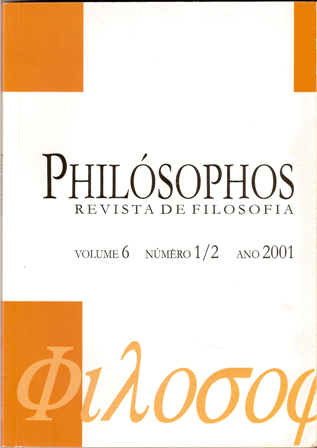
CHRISTINO, Daniel. ÉTICA E ONTOLOGIA EM KANT E TUGENDHAT. Philósophos a journal of philosophy, Goiânia, v. 6, n. 1/2, 2008. DOI: 10.5216/phi.v6i1/2.3128. Disponível em: https://revistas.ufg.br/philosophos/article/view/3128. Acesso em: 6 apr. 2026.
Issue
Section
Artigos Originais
License
Authors who publish in this journal agree to the following terms:
- Authors retain copyright and grant the journal right of first publication, with the work simultaneously licensed under a Creative Commons Attribution License that allows others to share the work with an acknowledgement of the work's authorship and initial publication in this journal.
- Authors are authorized to enter into separate, additional contractual arrangements for the non-exclusive distribution of the journal's published version of the work (e.g., publishing in an institutional repository or as a book chapter), with an acknowledgement of its authorship and initial publication in this journal.