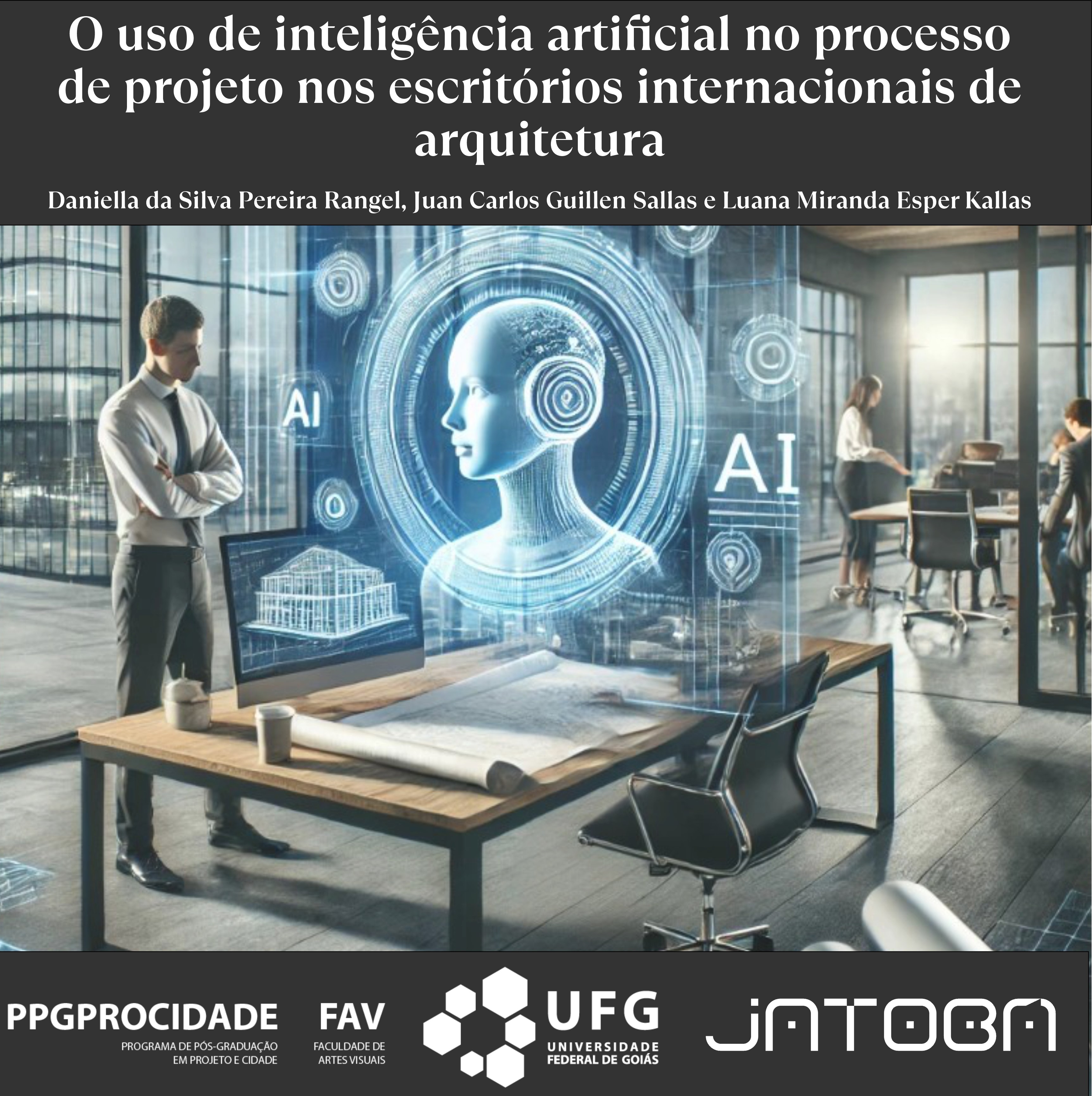
The use of artificial intelligence in the design process in global architecture offices
DOI:
https://doi.org/10.5216/revjat.v6.80253Keywords:
Artificial Intelligence. Zaha Hadid Architects, Foster Partners. MidJourney. Dalle-3. Stable Diffusion.Abstract
Considering that architecture has been profoundly impacted by technological advancements and that artificial intelligence (AI) emerges as a disruptive tool in the field, the objective is to understand how AI is being utilized in the architectural design process by renowned firms such as Zaha Hadid Architects and Foster + Partners. To this end, the study analyzes interviews, case studies, and practical experiments with AI software such as Midjourney, DALL-E 3, and Stable Diffusion, aiming to explore their applications and impacts on creative processes.In this context, it is observed that AI plays a significant role in optimizing processes and expanding architectural creativity, enabling the generation of innovative forms. Tools like Midjourney and DALL-E 3 offer accessibility and speed, while the more technical Stable Diffusion stands out for its customization capabilities. These advancements allow architects to combine technology and creativity, creating more efficient and bold solutions. The study concludes that, although AI expands possibilities in design, its effective use depends on technical expertise and strategies that balance innovation with the preservation of intellectual property.
Downloads
References
BURRY, M. Scripting Cultures: Architectural Design and Programming. Wiley, 2011.
CHIU, Thomas K.F. The Impact of Generative AI (GenAI) on Practices, Policies and Research Direction in Education: A Case of ChatGPT and Midjourney. Interactive Learning Environments, 2023. Disponível em: https://doi.org/10.1080/10494820.2023.2253861. Acesso em: 1 ago. 2024.
DEZAINE. A Inteligência Artificial pode derrubar as indústrias criativas?, 2023. Disponível em: https://www.dezaine.co.mz/inicio/a-inteligncia-artificial-pode-derrubar-as-indstrias-criativas?. Acesso em: 5 ago. 2024.
FOSTER + PARTNERS, . Innovation through technology: genetic algorithms, 2023b.Disponível em: https://www.fosterandpartners.com/news/innovation-through-technology-genetic-algorithms. Acesso em: 1 ago. 2024.
FOSTER + PARTNERS. Applied R+D, 2024. Disponível em: https://www.fosterandpartners.com/people/teams/applied-rplusd. Acesso em: 1 ago. 2024.
FOSTER + PARTNERS. Design, Technology, and the Team Between | +Plus Journal, 2023a. Disponível em: https://www.fosterandpartners.com/insights/plus-journal/design-technology-and-the-team-between. Acesso em: 1 ago. 2024.
FOSTER + PARTNERS. Foster + Partners collaborates with NVIDIA Omniverse Enterprise for the AEC industry, 2021. Disponível em: https://www.fosterandpartners.com/news/foster-plus-partners-collaborates-with-nvidia-omniverse-enterprise-for-the-aec-industry. Acesso em: 1 ago. 2024.
GALLO, Giuseppe; TUZZOLINO, Giovanni Francesco; WIRZ, Fulvio. The role of artificial intelligence in architectural design: conversation with designers and researchers. In: SÖLLNER, Matthias (Ed.). Proceedings of S.Arch 2020, the 7th international conference on architecture and built environment. Tokyo: S.Arch. p. 198-206, 2020.
HABITABILITY. Arquitetura ainda não precisa da inteligência artificial, diz Norman Foster, 2023. Disponível em: https://habitability.com.br/arquitetura-ainda-nao-precisa-da-inteligencia-artificial-diz-norman-foster. Acesso em: 5 ago. 2024.
HE, Wanyu. Architects Sketch. In: DIGITALFUTURES. Workshops 2020. [S.l.]: DigitalFUTURES, 2020. Disponível em: <https://digitalfutures.international/workshops-2020/.> Acesso em: 5 ago. 2024.
LEACH, Neil. Architecture in the Age of Artificial Intelligence: An Introduction to AI for Architects. London: Bloomsbury Visual Arts, 2022.
NEGAHBAN, S., & SMITH, J. AI in Architecture: An Emerging Revolution. Journal of Architectural Innovation, 2019, 23(1), 15-22.
OVERBEEK, Ashley. Screen Time: A Conversation with Neil Leach, 2023. Disponível em: https://gagosian.com/quarterly/2023/11/01/interview-screen-time-a-conversation-with-neil-leach/. Acesso em: 5 ago. 2024.
POZZEBON, Eliane, FRIGO, Luciana, BITTENCOURT, Guilherme. Inteligência Artificial Na Educação Universitária: Quais As Contribuições?, 2022. Disponível em: < https://www.researchgate.net/publication/242091111_INTELIGENCIA_ARTIFICIAL_NA_EDUCACAO_UNIVERSITARIA_QUAIS_AS_CONTRIBUICOES>. Acesso em: 5 ago. 2024.
ROSA, J., & ESTEVES, F. The Impact of AI in Modern Architectural Practices. International Journal of Architectural Computation, 15(3), 60-74, 2022.
SCHUMACHER, Patrik. Parametricism and the Possibilities of Computational Design. Architectural Design, v. 79, n. 4, 2009.
YAKUBU, Paul. Rayon: um software que revoluciona o desenvolvimento de projetos colaborativos. Tradução de Walter Gagliardi, 2023. Disponível em: https://www.archdaily.com.br/br/1007673/rayon-um-software-que-revoluciona-o-desenvolvimento-de-projetos-colaborativos. Acesso em: 5 ago. 2024.
ZAHA HADID ARCHITECTS. Architecting the Metaverse, 2022. Disponível em: https://www.zaha-hadid.com/design/architecting-the-metaverse/. Acesso em: 1 ago. 2024.
Downloads
Published
How to Cite
Issue
Section
License
Copyright (c) 2024 Jatobá Journal

This work is licensed under a Creative Commons Attribution 4.0 International License.
- Autores mantém os direitos autorais e concedem à revista o direito de primeira publicação, com o trabalho simultaneamente licenciado sob a Licença Creative Commons Attribution 4.0 que permite o compartilhamento do trabalho com reconhecimento da autoria e publicação inicial nesta revista.
- Autores têm autorização para assumir contratos adicionais separadamente, para distribuição não-exclusiva da versão do trabalho publicada nesta revista (ex.: publicar em repositório institucional ou como capítulo de livro), com reconhecimento de autoria e publicação inicial nesta revista.
- Autores têm permissão para publicar e distribuir seu trabalho online (ex.: em repositórios institucionais ou na sua página pessoal) após a publicação inicial nesta revista, já que isso pode gerar alterações produtivas, bem como aumentar o impacto e a citação do trabalho publicado (Veja O Efeito do Acesso Livre).
- Foram feitos todos os esforços para identificar e creditar os detentores de direitos sobre as imagens publicadas. Se tem direitos sobre alguma destas imagens e não foi corretamente identificado, por favor, entre em contato com a revista Jatobá e publicaremos a correção num dos próximos números.