REFERIR-SE-ÃO AS CATEGORIAS PSICOLÓGICAS ORDINÁRIAS A CAUSAS INTERNAS DO COMPORTAMENTO?
DOI:
https://doi.org/10.5216/phi.v18i1.20560Palavras-chave:
categorias psicológicas, teoria causal da mente, comportamento, behaviorismo.Resumo
A abordagem de Armstrong e Lewis sobre os conceitos psicológicos ordinários pretende-se uma síntese entre behaviorismo e cartesianismo. Ela sustenta, fundamentalmente, duas teses: (a) a de que esses conceitos, em geral, explicam e predizem comportamentos pela designação de entidades internas (isto é, próprias do interior do corpo) que são os ocupantes de papéis de causar os respectivos comportamentos; e (b) a tese de que os ocupantes desses papéis causais identificam-se com entidades cerebrais e, eventualmente, substratos internos de outras constituições físicas, no sentido de identidades de tipos (e não de particulares), ainda que restringidas. Por um lado, a abordagem é formulada em oposição à ideia de que os conceitos em questão não se referem a causas internas; mas, por outro, propõe uma forma de visão materialista e entende esses conceitos como possuindo conexões lógicas com relações comportamentais do organismo como um todo com aspectos do ambiente maior. O presente trabalho procura sugerir (1) que tal abordagem é implausível, levantando a ela várias objeções; e (2) que as objeções de Armstrong e Lewis a perspectivas comportamentais não atingem pelo menos uma específica deste tipo, aqui esboçada brevemente e apoiada.Downloads
Não há dados estatísticos.
Downloads
Publicado
18-12-2012
Como Citar
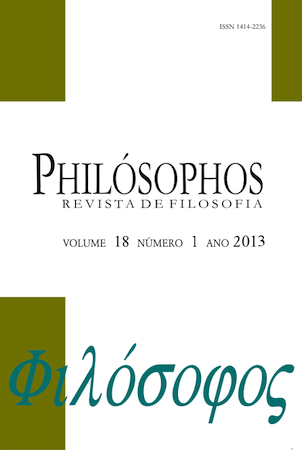
LAZZERI, Filipe. REFERIR-SE-ÃO AS CATEGORIAS PSICOLÓGICAS ORDINÁRIAS A CAUSAS INTERNAS DO COMPORTAMENTO?. Philósophos - Revista de Filosofia, Goiânia, v. 18, n. 1, p. 41–73, 2012. DOI: 10.5216/phi.v18i1.20560. Disponível em: https://revistas.ufg.br/philosophos/article/view/20560. Acesso em: 12 abr. 2026.
Edição
Seção
Dossiê de Artigos Originais
Licença
Autores que publicam nesta revista concordam com os seguintes termos:
- Autores mantêm os direitos autorais e concedem à revista o direito de primeira publicação, sendo o trabalho simultaneamente licenciado sob a Creative Commons Attribution License o que permite o compartilhamento do trabalho com reconhecimento da autoria do trabalho e publicação inicial nesta revista.
- Autores têm autorização para assumir contratos adicionais separadamente, para distribuição não-exclusiva da versão do trabalho publicada nesta revista (ex.: publicar em repositório institucional ou como capítulo de livro), com reconhecimento de autoria e publicação inicial nesta revista.